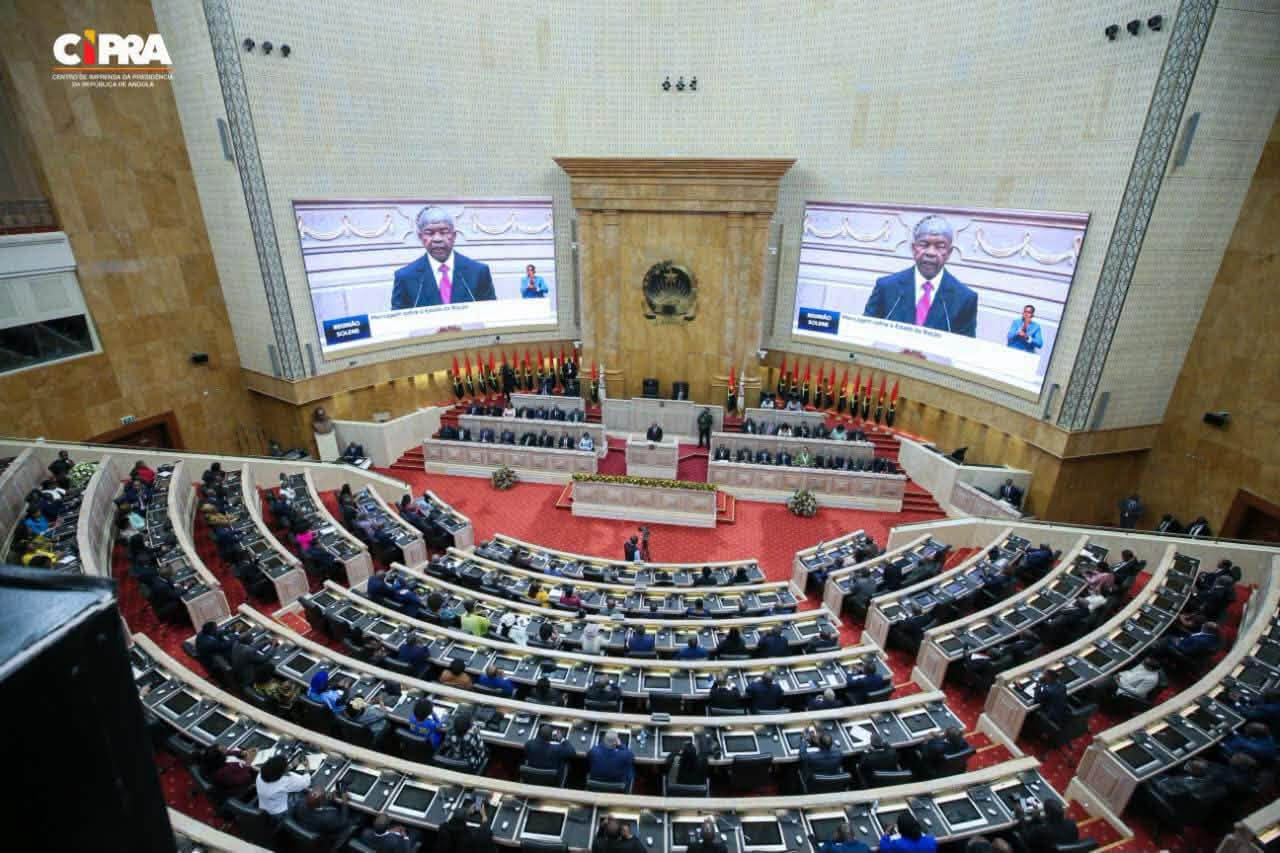
President João Lourenço used yesterday’s State of the Nation address to present an Angola making measurable progress: faster economic growth, falling inflation and public debt, stronger non-oil activity, new infrastructure and an expanding state presence in sectors from healthcare to transport.
But what do those indicators tell us about the state of the country as Angola approaches the 2027 elections?
In the latest Angola Briefing, Zitamar editor-at-large Fernando Lima discusses Lourenço’s record with Claudio Silva, Zitamar’s new contributing editor in Luanda.
The programme begins with a short introduction from Zitamar founder Tom Bowker to our work, the subscription-funded journalism Zitamar has built over the past decade, and why we are now expanding our coverage of Angola.
Growth is real. Is it enough?
Lourenço had some striking numbers to present.
Angola’s economy grew 5.3% year-on-year in the first quarter of 2026, according to figures cited by the president, with the non-oil economy expanding 6.2%. Inflation, he said, had fallen from 27.5% in 2024 to 10.8% in June 2026, while public debt had declined from 115.9% of GDP in 2020 to 51.2% this year. He also cited a fall in unemployment from 31.5% in 2024 to 21.3% in the first quarter of 2026. Governo de Angola
The argument in the Briefing is not simply that these improvements are fictitious.
Silva is sharply critical of some official statistics — particularly unemployment figures — but also acknowledges that non-oil growth is real and that the broad direction of some economic indicators is supported by international institutions.
That produces a more important question: is Angola’s economy improving quickly enough to improve the lives of a young and rapidly growing population?
Silva argues that population growth changes the significance of headline GDP growth. Angola has to create employment, schools, healthcare and economic opportunities quickly enough not merely to expand the economy, but to accommodate millions of young people entering adulthood.
That helps explain how positive macroeconomic indicators can coexist with considerable economic frustration. It also changes the test for diversification. Growth outside oil matters, but so do the sectors generating it, the jobs they create and the extent to which rising output reaches households.
What should count as a job?
That tension becomes particularly sharp over unemployment.
Silva questions the official figures and argues that changes in the treatment of informal economic activity make comparisons over time difficult. His criticism goes further at points, questioning the credibility of INE statistics themselves.
That should be treated as Silva’s contention, not an established finding that Angola’s statistics are deliberately manipulated.
But the argument raises a substantive issue regardless of whether one accepts his stronger criticism. In a country where informal employment is extensive, a person can technically be economically active while remaining poor, insecure and without anything resembling a salaried job.
A falling unemployment rate therefore does not by itself answer the question Lourenço’s speech ultimately poses: whether economic conditions for Angolans are materially improving.
Silva also points to migration as another possible measure of confidence in Angola’s trajectory, highlighting the rapid increase in Angolans moving to Portugal. His argument is that migration by people with the means and skills to leave should be considered alongside conventional economic indicators: when Angolans have choices, where do they see their future?
The political legacy of 2017
The discussion also looks backwards.
Lourenço did not come to office in 2017 merely as another MPLA president. His early moves against figures associated with José Eduardo dos Santos, his anti-corruption campaign and the greater sense of political openness surrounding his first years created expectations that Angola might be entering a substantially different era.
Silva argues that much of that goodwill has since disappeared.
That is his political assessment rather than something demonstrated by the State of the Nation address itself. But it identifies an important benchmark for Lourenço’s final stretch before the 2027 election: he will be judged not only against the Angola he inherited, but against the expectations his own presidency created.
Fernando Lima presses Silva on the alternative. Is UNITA leader Adalberto Costa Júnior offering a sufficiently convincing programme of government, or does opposition simply give him the easier task of attacking the MPLA’s record?
Silva argues that Costa Júnior has become more concrete in his policy proposals and that his style is better suited to communicating with Angola’s young electorate.
The question becomes increasingly important as 2027 approaches. Dissatisfaction with an incumbent government does not automatically translate into confidence in the opposition.
Autarquias expose the bigger problem
The most revealing exchange in the programme comes over autarquias — the elected local governments that Angola has debated for years but has still not introduced.
Lourenço returned to the issue in his State of the Nation address. Thirteen pieces of legislation were originally proposed and most have been approved, but disagreement remains, including over whether the first local elections should take place simultaneously across the country or be phased in.
Although the MPLA has the parliamentary numbers to proceed, Lourenço said it would be inadvisable to settle such a sensitive issue through the ruling party’s majority alone, and called for greater political consensus. Home
Silva’s interpretation is much more political. He argues that the failure to introduce autarquias reflects reluctance within the MPLA to surrender municipal power in places where it might lose elections.
That claim about the ruling party’s motives is his analysis. But Fernando’s response exposes another problem: what would political decentralisation actually mean economically?
If municipalities were elected tomorrow, he asks, how many would possess a sufficient tax base to sustain themselves rather than continuing to depend on Luanda?
Silva concedes that many would not.
His counterargument is that this dependence is partly a product of the system that decentralisation is intended to change. Provincial governors are presidential appointees, municipal authority flows down through the central state, and economic and fiscal decision-making remains heavily concentrated in Luanda.
In that reading, requiring municipalities to demonstrate economic independence before giving them greater political and fiscal authority risks creating a circular argument: they cannot become more autonomous because the centralised system has left them dependent on the centre.
The result is a much bigger question than when Angola will finally hold municipal elections. How much political authority, revenue and responsibility is the central state actually prepared to give up?
That also connects directly to a subject discussed in last week’s Angola Briefing on Angola beyond Luanda: the enormous concentration of political and economic decision-making in the capital and the difficulty of turning resource wealth and large infrastructure investments into locally driven development.
And what happens to Lourenço?
The final phase of Lourenço’s presidency also hangs over the discussion.
Silva notes that Lourenço did not explicitly describe Thursday’s address as his final State of the Nation and says the omission has contributed to speculation in Angola about whether the president might seek to remain in office beyond the expected end of his second term.
The programme presents no evidence that Lourenço intends to seek a third presidential term, and the speculation should not be mistaken for such evidence.
But it reflects a wider uncertainty that is becoming harder to separate from Angolan politics: who will lead the MPLA into the next election, what role Lourenço himself intends to retain, and how the ruling party manages its succession.
The discussion ultimately goes further still, questioning the constitutional structure under which Angolans elect a party list whose head becomes president, rather than voting separately for the head of state.
Silva argues that constitutional reform should form part of the post-Lourenço debate.
Whether that happens is another matter. But as Angola moves towards 2027, the State of the Nation is increasingly difficult to separate from a different question: what kind of political system will Lourenço leave behind?
Watch the full Angola Briefing
The programme also discusses the credibility of official statistics, Angola’s informal economy, migration to Portugal, public spending on education and health, Adalberto Costa Júnior and UNITA, speculation about Lourenço’s political future, the MPLA succession and the case for constitutional reform.