Welcome to the Angola Briefing, Zitamar News’ guide to the political, economic and business developments shaping Angola. Each edition combines the latest reporting with analysis from journalists and specialists who know the country closely.
Yesterday afternoon, host and Zitamar editor-at-large Fernando Lima was joined by Marisa Lourenço, a political-risk analyst and strategic adviser covering energy and investment across southern Africa, and Francisco Miguel Paulo, an Angolan economist and researcher specialising in taxation, fiscal policy and economic diversification.
They discussed Angola’s falling inflation and the Banco Nacional de Angola’s increasingly optimistic growth outlook, new figures showing that most construction projects surveyed across the country are paralysed, and Angola’s inclusion in a new JPMorgan emerging-market debt index.
In IN FOCUS, we turn to Angola’s oil industry following the Angola Oil & Gas conference earlier this month: can new discoveries and investment keep production around 1m barrels per day, and can Angola finally turn more of its hydrocarbons into domestic economic value?

Sign up to Zitamar News and select the Angola Briefing newsletter to receive every issue in your inbox.
THE LATEST NEWS
BNA cuts rates as inflation falls below 9% and raises growth forecast
The Banco Nacional de Angola has cut its benchmark interest rate from 15.75% to 14.75% and reduced banks’ local-currency reserve requirement from 17.5% to 16.5%, after annual inflation fell to 8.78% in August from 9.33% in July. The BNA also sharply upgraded its forecast for economic growth this year to 6.15%, from 3.6% previously. Inflation has fallen substantially from 18.88% a year earlier, although price pressures remain considerably higher in some important areas: education prices rose 19.33% year-on-year, food and non-alcoholic beverages 9.94%, and health 9.66%.
Analysis: Francisco Paulo said returning to single-digit inflation is an important macroeconomic achievement, but stressed that households are unlikely to feel much immediate relief because prices are still rising and purchasing power remains weak. He also questioned how effectively lower policy rates translate into cheaper or more accessible credit in an economy where businesses face structural obstacles to obtaining bank finance. Marisa Lourenço likewise cautioned against equating better headline numbers with better living standards, and said the striking gap between the BNA’s growth forecast and those of institutions such as the IMF merits scrutiny — while acknowledging that the central bank has access to more recent and granular data. Paulo added that the bigger test of Angola’s reported non-oil growth is whether it begins to generate formal employment, rather than further expansion of the informal economy.
Nearly eight in ten construction projects surveyed by INE are paralysed
Sources: INE · Valor Económico
Of 5,691 construction projects surveyed by the National Statistics Institute in the second quarter of 2026, 4,450 were paralysed and only 1,241 remained under construction — meaning just over 78% of the sites visited were stalled. Benguela was particularly badly affected, while the national survey also shows that most of the sites covered are family-led or self-build projects rather than developments undertaken by large private companies.
Analysis: Paulo said the figures help qualify the upbeat story being told by headline non-oil growth: construction was once one of the principal motors of Angola’s post-war expansion, but its growth is now far weaker. He cautioned, however, that the survey does not make it straightforward to compare the economic importance of a stalled family home with that of a major commercial or public project. Lourenço said the figures expose deeper weaknesses in Angola’s financial system: developers struggle to finance projects while households have little access to mortgages, creating a cycle in which buildings remain unfinished despite strong underlying housing demand. Large public works can meanwhile bolster aggregate construction figures even while much of the smaller-scale building economy remains stagnant.
Angola joins JPMorgan’s new emerging-market local-currency debt index
Sources: Valor Económico · Africa Index
Angola has been selected for JPMorgan’s new GBI-EM Edge index, a benchmark for local-currency government debt in smaller emerging and frontier markets that is expected to launch before the end of September. The reported launch universe comprises 26 countries, including 14 in Africa, although JPMorgan had not yet publicly confirmed the final country weightings when Angola’s inclusion was reported. Membership should give kwanza-denominated government debt greater visibility among international institutional investors.
Analysis: Lourenço described inclusion as another small but meaningful sign of Angola’s increasing integration into international capital markets, but cautioned that it is not a “silver bullet” for weaknesses in the domestic financial system. Paulo said the index could support the government’s longer-term effort to diversify its financing sources by encouraging international investors to buy kwanza-denominated domestic debt rather than Angola relying as heavily on foreign-currency bonds and bilateral borrowing. Both therefore saw the development as positive primarily because of the visibility and potential investor access it creates, rather than as evidence that Angola has already developed a deep and liquid capital market.
IN FOCUS: Angola’s oil industry fights to hold the line
The Angola Oil & Gas conference held in Luanda earlier this month suggested that the country’s petroleum sector is in better shape than it was a few years ago. New discoveries were announced, major international companies signed fresh agreements, and the government used the event to project confidence in the industry’s future.
That is a notable change from the persistent narrative of decline that has hung over Angolan oil for much of the past decade. But it does not yet amount to a return to growth. As Monday’s Angola Briefing made clear, the more immediate achievement has been to stabilise production at around 1m barrels a day — a respectable outcome for a mature offshore producer, but a long way from the boom years.
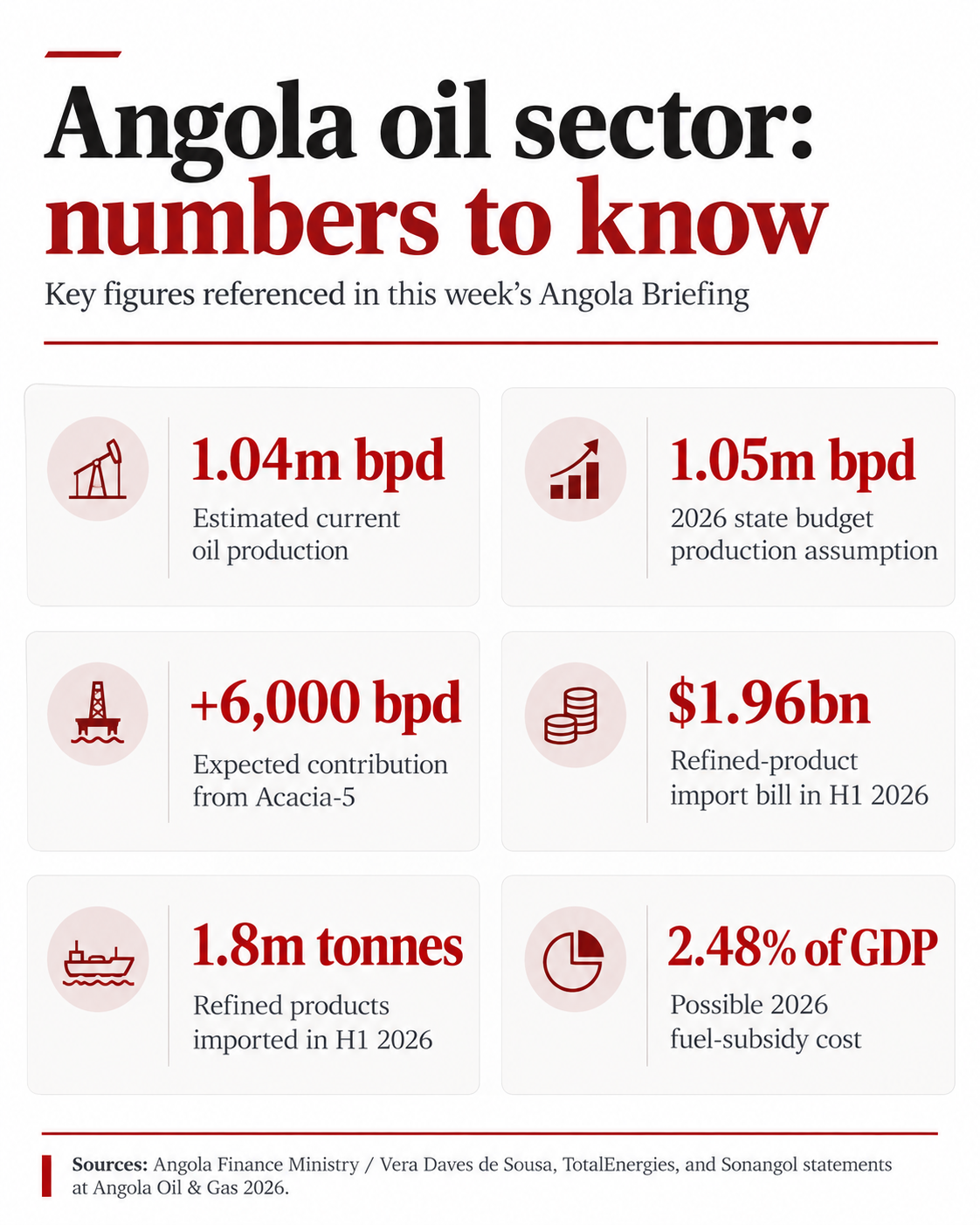
Angola is currently producing about 1.04m barrels a day, close to the 1.05m bpd assumption in the 2026 budget. For Marisa Lourenço, who attended the conference, that in itself is significant. Angola’s mature fields are naturally declining, so simply holding production steady requires continual investment.
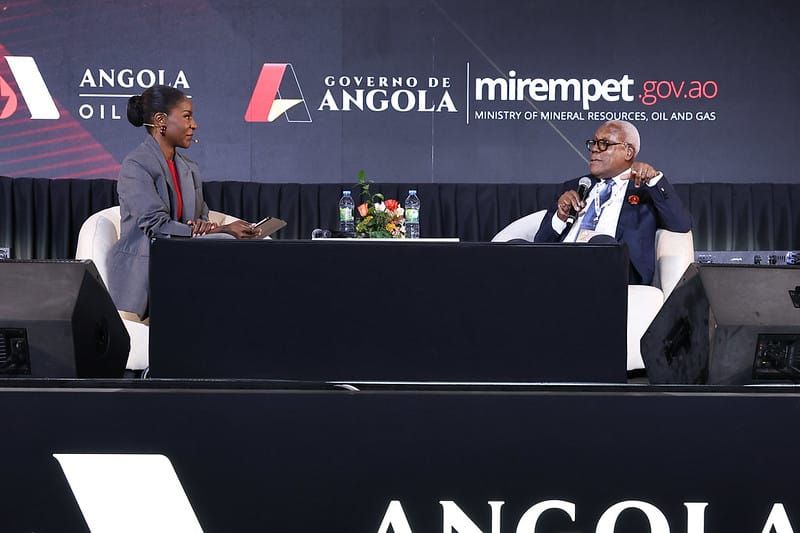
“The government has to work very hard so that it doesn’t go below current production levels,” she said during the webinar. “It seems like it has managed to arrest that for now.”
Francisco Paulo took a similar view, though with greater emphasis on what that means in practice. Much of the investment now being announced, he argued, is not the beginning of a new petroleum boom but the cost of preventing a sharper fall in output.
That distinction matters. Angola may be succeeding in managing decline more effectively, but that is not the same thing as rebuilding the industry to anything like its former scale.
Smaller gains, better used
The developments announced at the conference support that reading. ExxonMobil reported another discovery in Block 15 at Vicango Este-01, while TotalEnergies said its Acacia-5 discovery in Block 17 is expected to add about 6,000 bpd through a tie-back to the existing Pazflor production system.
Neither announcement suggests a transformational discovery. Both are nonetheless important. They show how Angola can extract more value from a mature basin by linking smaller finds to infrastructure already in place. In an industry where new standalone offshore developments are expensive and slow to deliver, that is a sensible strategy.
The same logic underpins efforts to encourage new spending on older assets. Angola is trying to squeeze more life out of existing fields and processing infrastructure rather than depending solely on giant new discoveries. That may prove a more realistic model for the next phase of the sector.
A broader investor base
There are also tentative signs of renewed exploration interest. During the conference, ANPG formalised risk-service contracts with Shell, Equinor and Sonangol for Blocks 19, 34 and 35. The regulator also advanced arrangements with Shell, QatarEnergy and Sonangol on Blocks 8 and 22 in the Kwanza Basin.
That matters less for any immediate production gain than for what it says about investor sentiment. Shell’s deeper re-engagement and QatarEnergy’s presence suggest that Angola’s regulatory reforms and revised commercial terms are having some effect. Whether they lead to commercially significant new reserves is another matter: exploration agreements still have to result in wells, discoveries and development plans.
Lourenço also highlighted growing interest from Gulf investors. That gained further weight after the conference when Oman’s state energy group OQ and Sonangol signed a cooperation framework covering oil and gas, LNG, fertilisers, ammonia, petrochemicals and trading.
The governments of Angola and Oman also signed broader energy agreements covering upstream, midstream and downstream cooperation.
These remain frameworks for possible cooperation rather than firm project commitments. Even so, they point to a sector attracting interest from a more diverse group of partners.
The old contradiction remains
The more difficult question is whether Angola can generate more domestic value from the hydrocarbons it produces. The contradiction is familiar: Angola is a major crude exporter but remains heavily dependent on imported refined fuels.
At the conference, Sonangol said Angola imported about 1.8m tonnes of refined petroleum products in the first half of 2026 at a cost of roughly $1.96bn. The government wants to reduce that dependence through an expansion of refining capacity, notably at Lobito as well as through other projects.
Lourenço made the strategic case for refining clearly. Greater local processing would reduce Angola’s exposure to external fuel-supply shocks, lower import dependence and potentially create export opportunities in regional markets.
Paulo was more cautious about the economics. Refineries are expensive to build and operate, and their commercial logic depends not only on Angolan demand but on whether they can serve a wider regional market. Refining may make strategic sense, but its viability cannot simply be assumed.
That debate is sharpened by the continued fiscal burden of fuel subsidies. Finance minister Vera Daves de Sousa said this month that fuel subsidies could amount to 2.48% of GDP in 2026, compared with 0.9% envisaged in the budget. Higher oil prices improve crude revenues but also raise the cost of keeping domestic fuel prices below market levels.
Paulo suggested that the political room for further subsidy reform is limited, particularly as the 2027 elections approach. The government has not said it is abandoning the reform, but its political sensitivity is clear.
A more modest ambition
What emerged from the webinar was a more measured view of Angola’s oil future than the conference rhetoric might imply. Angola is not on the verge of returning to the production levels of the 2000s. Nor is it simply presiding over unmanaged decline.
Instead, it appears to be pursuing a more modest strategy: prolong production from mature fields, attract enough exploration capital to slow reserve depletion, and capture more value through refining, gas and other downstream activity.
There is promise in that approach, but also considerable uncertainty. New exploration must yield commercially meaningful discoveries. Refining projects must prove viable at scale. And the government still has to turn the ambition of adding value to petroleum production into industries capable of generating employment and investment beyond the upstream oil sector.
For now, holding production close to 1m barrels a day looks less like a staging post on the way back to Angola’s former output levels than an achievement in itself.
Thank you for joining us for this edition of the Angola Briefing.
We’ll be back on Thursday with another business-focused edition, looking at investing in Angola and the wider business environment, alongside our review of the latest political, economic and business developments.
Thanks again for watching, listening and reading.