
By the Numbers
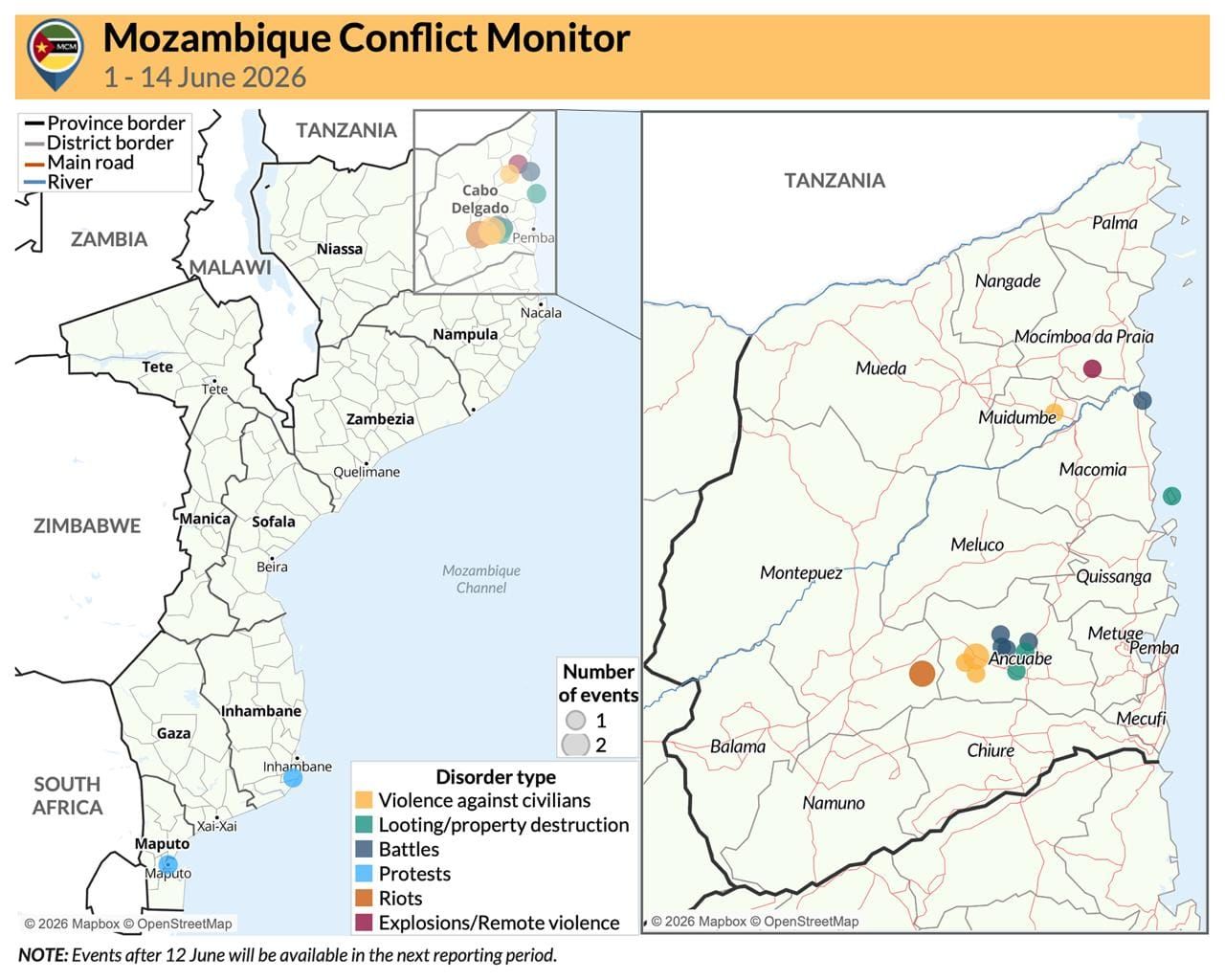
Data highlights in Cabo Delgado province (1 - 14 June 2026)
At least 11 political violence events (2,408 in total since 1 October 2017)
At least 8 total reported fatalities from political violence (6,632 since 1 October 2017)
At least 4 reported civilian fatalities (2,772 since 1 October 2017)
At least 11 political violence events involving ISM across Mozambique (2,224 since 1 October 2017)
Overview
After two months in southern Cabo Delgado, Islamic State Mozambique (ISM) insurgents have begun to return to bases in Macomia. They are likely a little richer, having passed through four informal mine sites during their time in the south. ISM also remained active in the north, deploying IEDs in Macomia and Mocímboa da Praia district and clashing with a Mozambican navy vessel. A clash between miners and police at the Namanhumbir ruby mines was a reminder that beyond the insurgency, natural resources remain contentious.
Situation summary
ISM return from the south
Having been in Ancuabe and Chiúre districts since mid-April, ISM militants seem to finally be making their way back to Macomia district. They are departing as they arrived, visiting informal mining sites and being largely undisturbed by either Mozambican or Rwandan security forces. During their time in southern Cabo Delgado, they were a threat to at least two large-scale commercial mining sites and upended the lives of over 21,000 people now living in displaced people’s centers in Ancuabe, Chiúre, and Montepuez districts.
Between 1 and 4 June, ISM militants were active in and around at least four villages in the Mesa area of Ancuabe district. Mpene to the west is a known ruby mining site, while there is an informal gold mine at N’naua to the east. At N’naua, they kidnapped an unknown number of people. According to one source, the victims were children. Another said the victims were miners and were released for a ransom of 10,000 meticais each.
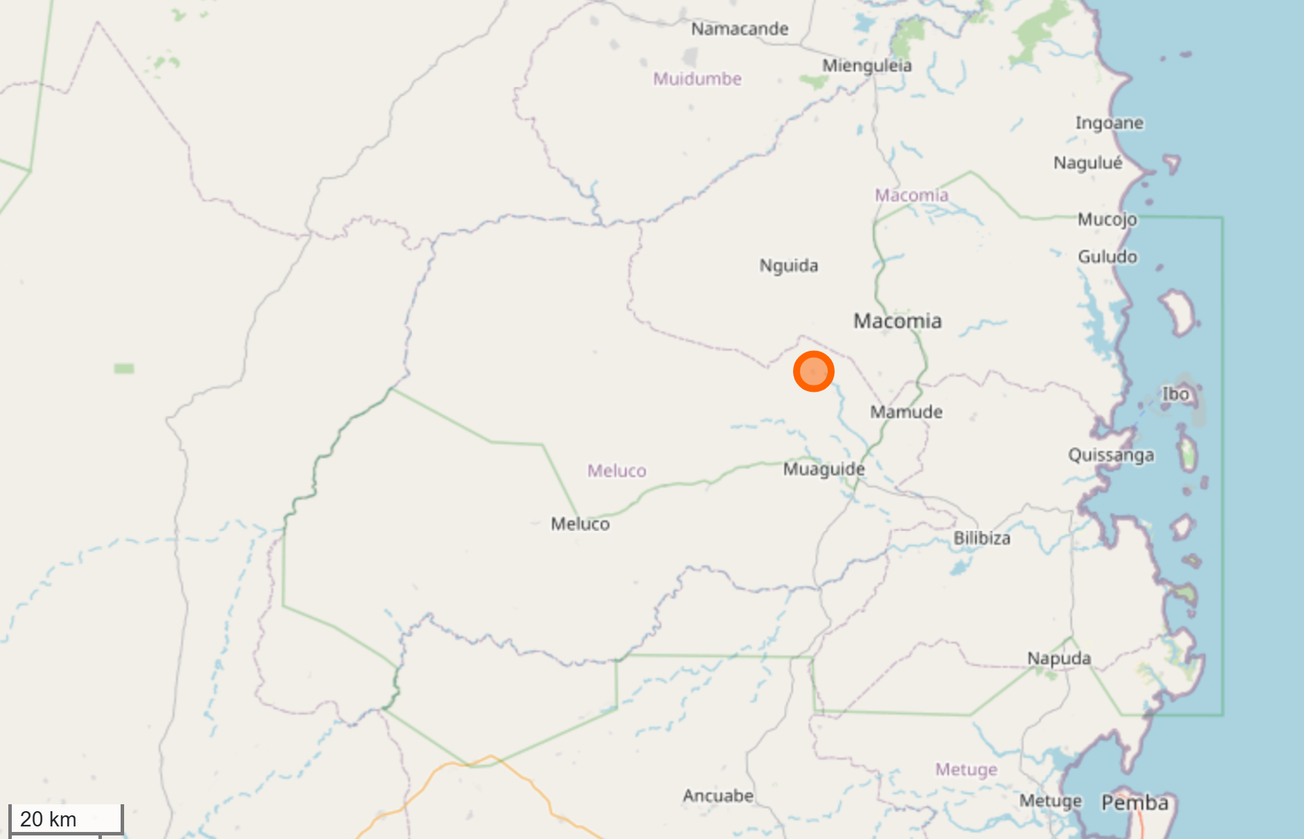
Fighters then made their way east toward Quissanga in at least two groups of 10 to 20 men each. According to a source, one group spent some time at an artisanal gold mine known as Nabala, approximately 15 kilometers southwest of Meluco town. In Quissanga, they went by Cagembe village, a site they regularly pass through.
Having visited at least four mining sites since mid-April, raised some money through ransom, and looted goods in numerous villages, ISM’s trip south has likely been worth it, as it likely was in November last year. The failure of the security forces to respond made this sojourn possible. There are two camps, one Rwanda Defence Force (RDF) and one Defense Armed Forces of Mozambique (FADM), where troops are well placed to respond to ISM’s sojourns south, but from which they rarely do. Without a strengthened, and more responsive, security presence in Cabo Delgado’s southern districts, ISM will undertake more such sojourns south as it seeks to strengthen control over informal mining operations and bring in recruits from Nampula.
Police and miners clash at Namanhumbir
ISM is not the only actor looking to control access to mining areas. According to a report in Moz24h, two people were killed in a clash between informal miners and an officer of the police Rapid Intervention Unit (UIR). The report claims that the officer was taking bribes to let miners into the mining area known as BCI, but soon after tried to force them to leave. According to the report, the UIR officer shot one miner before other miners overpowered him, seized his weapon, and shot him. The incident illustrates the persistently poor management of informal mining operations that presents a risk to large commercial operations through heightened insecurity. More fundamentally, it places miners’ lives at risk, whether at the hands of police or insurgents.
ISM attack in Macomia, Mocímboa da Praia, and Muidumbe districts
ISM remained active in the north while its larger force was in the south of the province. The Islamic State (IS) central media office claimed three IED attacks on Rwandan patrols between 1 and 4 June. Two of these, both on 1 June, near Limala in Mocímboa da Praia and in Cogolo village on the Macomia coast, were controlled explosions by the Rwandan forces, according to a security source. The successful attack occurred between Limala and Mbau in southern Mocímboa da Praia district. IS issued a video clip of this attack, showing a military truck being hit by an IED, likely detonated by command wire. The RDF has positions in Mbau, and in Mucojo on the coast.
Further east in the Muidumbe district, ISM insurgents entered Xitaxi village on 6 June, killing two people and stealing food, according to two sources. They were able to attack although FADM has a position at the eastern end of the village.
ISM and state forces clash at sea
ISM also remains active at sea. Local sources reported that militants landed on Matemo island on 2 June, where according to local sources they purchased food and destroyed a health center, having looted it of supplies. The following day, and 50 km north in waters off Quiterajo, ISM clashed with a Mozambican navy patrol. The clash occurred in an exclusion zone around the mouth of the Messalo river that FADM is trying to enforce.
Focus: IEDs as ISM’s first ring of defense
ACLED first records ISM deploying an IED in 2021. Since then, ACLED records 45 IED incidents involving ISM, of which 35 have been in Macomia and Mocímboa da Praia districts. Most deployments have been on roads that surround the Catupa forest, with the purpose of constraining the movement of FADM and Rwandan forces and discouraging approaches to ISM’s main camp (see map below). The IEDs in this way act as an outer defensive ring.
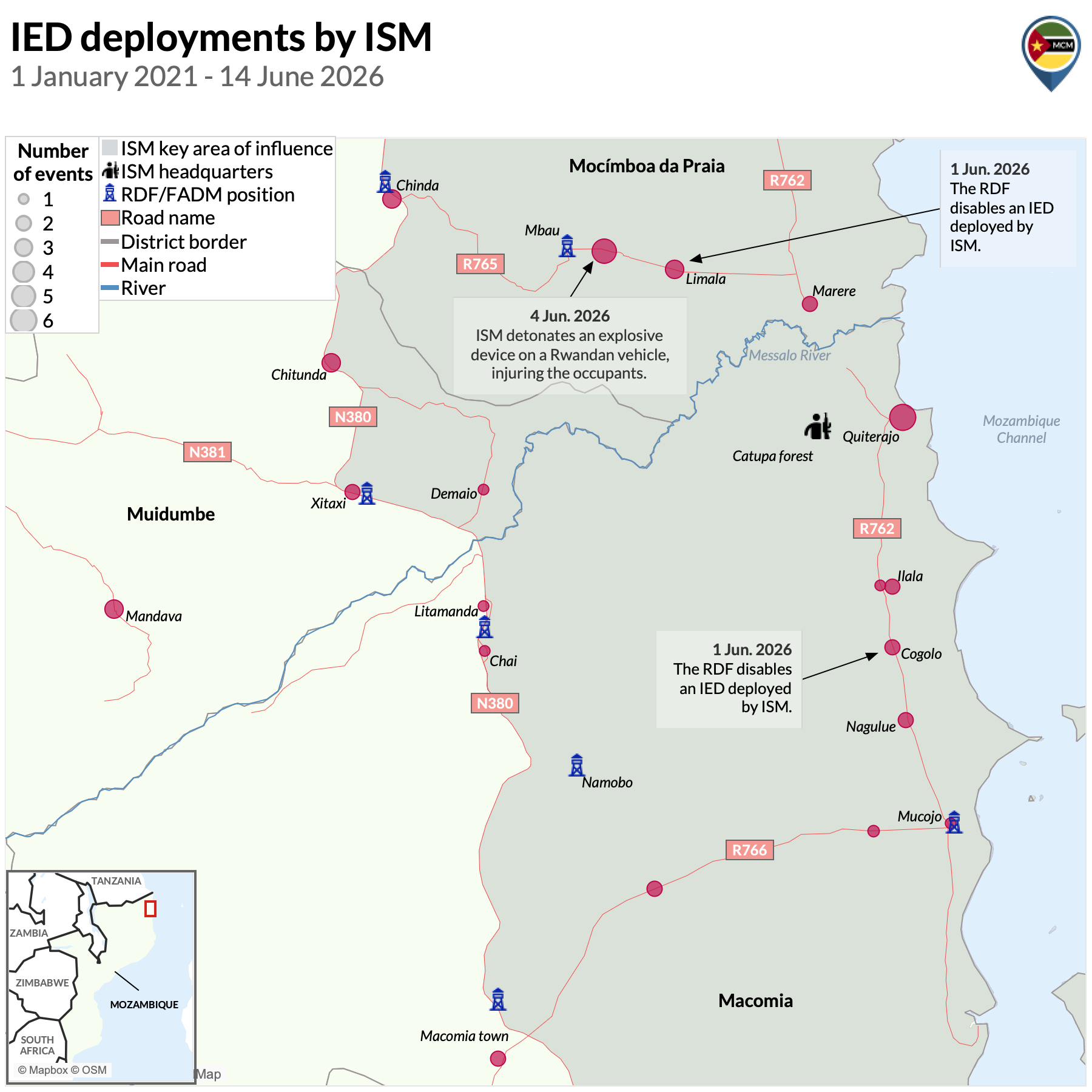
Still, ISM’s deployment of the three IEDs between 1 and 4 June, though the RDF identified and destroyed two, had impacts beyond the one successful detonation. Detection operations are defensive measures that tie up resources that could otherwise be involved in more proactive counter-insurgency operations. The impact of a successful IED deployment is much greater. This is seen first in the injury to soldiers in the vehicle struck, but also in the cost of recovery operations in the wake of such an attack.
The vehicle struck in southern Mocímboa da Praia was operating from the RDF’s Mbau base, from which regular patrols to Limala are made. The RDF’s aim is to at least restrict movement to and from the Messalo river basin from the Mocímboa da Praia side. Since 2021, ACLED records eight IED incidents on that stretch of road. This is not surprising, given the conditions on the ground (see graphic below). Vehicles traveling on a poor road, with heavy vegetation on either side, and numerous turns are particularly vulnerable to attack.
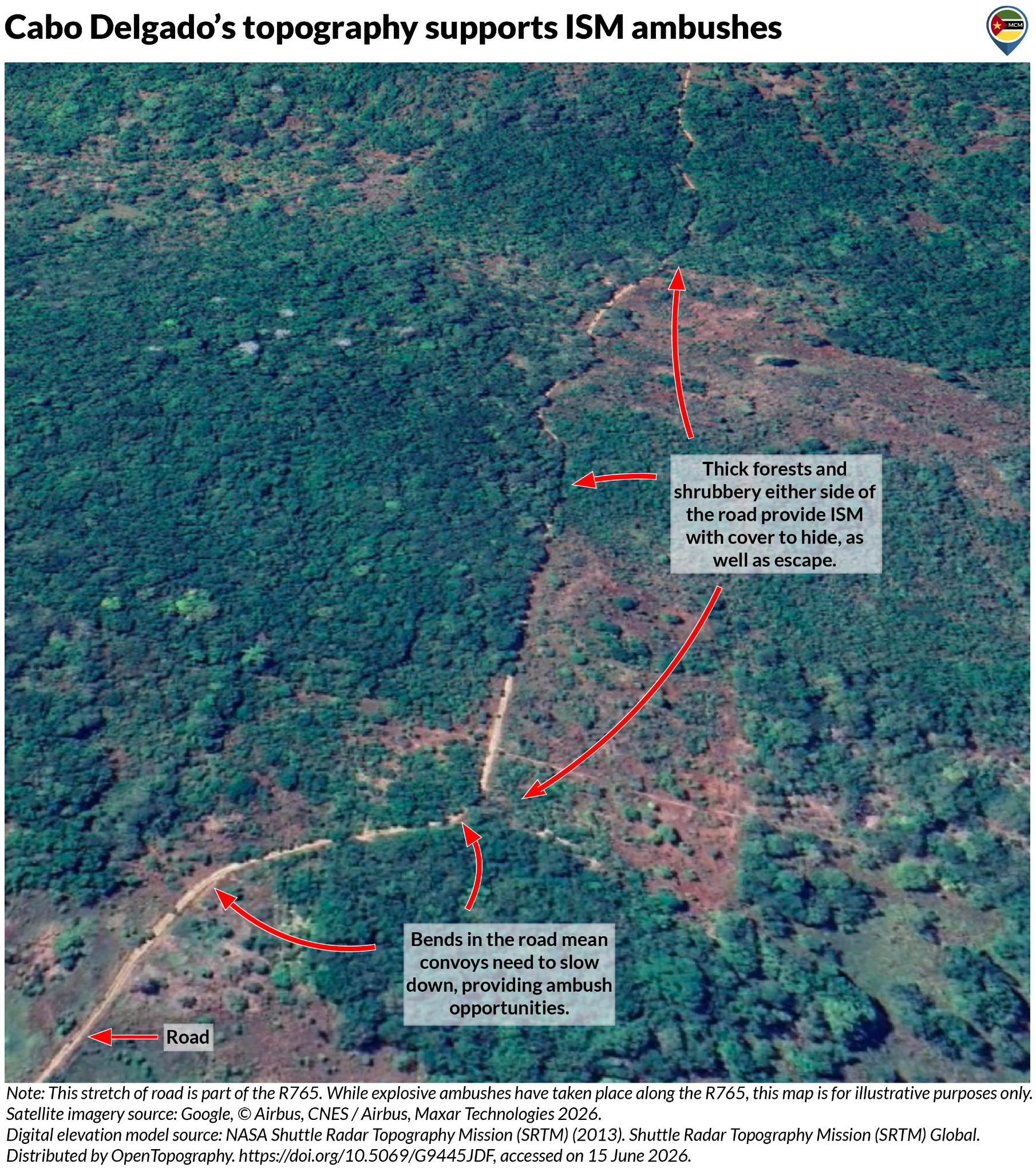
Combating IED use will require continued detection efforts. More fundamentally, it demands stopping the supply of explosives. The bomb maker or makers are likely in Catupa, so degrading ISM’s technical capacity is not likely feasible in the short term. In the meantime, they present a direct threat to state forces and their ability to degrade ISM’s operations, rather than civilian traffic. As the IEDs are detonated by command wire rather than by pressure, the bomber can target military traffic precisely, while his companion captures the moment on his phone for use in IS propaganda.
Roundup
Three people, including a priest, held over the killing of the Quelimane bishop
Osório Citora Afonso, the 54-year-old Catholic bishop of Quelimane and apostolic administrator of the Archdiocese of Beira, was shot dead in the early hours of 6 June at the Episcopal Palace in Quelimane, Zambézia province. The investigative agency Sernic said he was killed with an AKM-type firearm, struck in the chest near the heart, and that the body was found in a corridor. Investigators have arrested three people in connection with the killing, a Catholic priest of the Quelimane diocese, together with a guard and a gardener who worked at the bishop's residence. President Chapo, Pope Leo XIV, the European Union, and the United States all expressed shock, condemnation, and called for swift clarification of the crime and accountability for those responsible. At the same time, the Mozambican bishops conference and African church bodies pressed for a swift, transparent investigation into both the perpetrators and any masterminds behind the killing.
Mozambique and DRC agree to share counter-terrorism and mining expertise
The governments of Mozambique and the Democratic Republic of Congo have agreed to deepen bilateral cooperation by exchanging knowledge and experience in key areas, including counterterrorism, mining, energy, trade, and regional integration. Mozambican Foreign Affairs and Cooperation Minister Maria Lucas said both countries face terrorist threats and can benefit from sharing lessons learned and strengthening the capabilities of their security forces, with support from international partners such as the EU. The DRC also committed to sharing expertise in the management of mineral resources and energy sectors.
Cost dispute strains ties between Chapo and TotalEnergies chief
Relations between TotalEnergies CEO Patrick Pouyanné and Mozambican President Daniel Chapo appear to have soured over the French major’s 4.5 billion USD claim for cost overruns tied to the force majeure that halted Mozambique LNG between April 2021 and October 2025. A government-commissioned audit by the British firm Bayphase challenged part of that claim, finding much of the sum unjustified, and Mozambique is now resisting roughly $2 billion of the disputed costs. The two leaders are understood to have held at least one tense meeting recently, and Chapo has so far refused to amend the project's plan of development to absorb the new costs or revise the price of the two liquefaction trains.



)