
By the Numbers
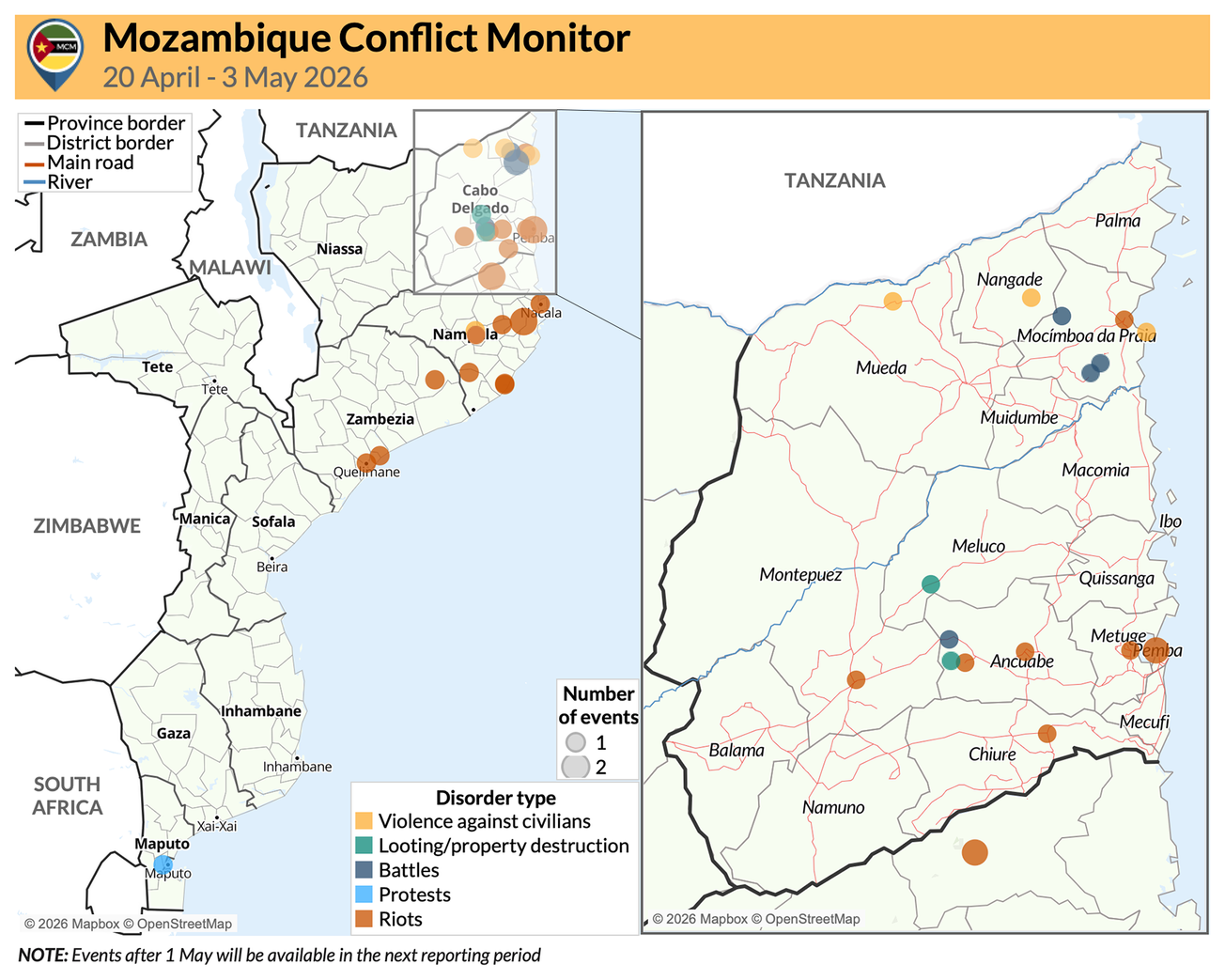
Data highlights in Cabo Delgado province (20 April - 3 May 2026)
At least 15 political violence events (2,371 in total since 1 October 2017)
At least 15 total reported fatalities from political violence (6,542 since 1 October 2017)
At least 8 reported civilian fatalities (2,747 since 1 October 2017)
At least 7 political violence events involving ISM across Mozambique (2,191 since 1 October 2017)
Overview
Islamic State Mozambique (ISM) clashed with Mozambican and Rwandan forces in Nangade and Mocímboa da Praia districts, killing at least seven Mozambican soldiers and seizing weaponry. In the south of the province, a group of up to 100 fighters took over two artisanal gold mining sites, looking for gold in one and money in the other. At one site, they repelled a detachment of Mozambican soldiers before moving south, where they burned a well-known Catholic church, sparking considerable displacement. The group remains in the area, presenting a threat to civilian communities, as well as to artisanal and commercial mining operations.
Situation summary
ISM kills seven and displaces hundreds in northern Cabo Delgado
Islamist insurgents remain active close to the Tanzanian border, adding weight to ongoing concerns that links with support networks across the border are currently operational. At least two groups of ISM militants have been active across the Mueda and Nangade districts bordering Tanzania. On 20 April, a group of about nine fighters entered Nkonga village in Nangade. As they often do, the fighters fired their weapons as they approached, prompting people to flee and clearing the way for the group to take supplies. Those who fled Nkonga were among the more than 700 people who, fearing attack, left villages in that part of Nangade district between 17 and 25 April, according to the International Organization for Migration.
Three days later, a group of ISM fighters, likely those who appeared in Nkonga, attacked a Defense Armed Forces of Mozambique (FADM) outpost at Mitope, just over the district boundary in Mocímboa da Praia. Islamic State (IS) media channels claimed that militants killed seven FADM soldiers in the attack. Photos released by IS showed soldiers clad in T-shirts, clearly not ready for combat. The group also seized weapons and ammunition. An image published in IS’ weekly al-Naba showed two incomplete mortars with ammunition, three medium machine guns, up to 25 other weapons including automatic rifles and small machine guns, and various types of ammunition.
A second group was active in Mueda district before returning to Nangade. On 23 April, armed men opened fire on a passenger bus running from Mueda town to Tanzania. The attack took place near Roma village, approximately 60 kilometers from Mueda town. According to a witness, insurgents dressed in military gear appeared on the road and tried to force the bus to stop, firing on the vehicle when the driver refused. Though the driver was hit, others took the wheel in turn, and the bus reached Tanzania, where it was met by Tanzanian security forces. According to a Mozambique Conflict Monitor source in the district, the group returned to Nangade and was spotted near Samora Machel village on 25 April.
RDF and FADM clash with ISM in southern Mocímboa da Praia
State forces clashed twice with ISM in southern Mocímboa da Praia. On 29 April, Rwandan forces clashed with ISM on the road between Mbau and Naquitengue, incurring an unknown number of fatalities, according to an IS claim released on Telegram. The same day, according to a subsequent IS claim, militants clashed with Mozambican forces at Mbau village, with no fatalities. A source in Mocímboa da Praia confirms that clashes occurred that day in broadly the same area as IS claims. According to the source, on 29 April, two former insurgents led army soldiers to a supposed hiding spot, then fired on it. According to this source, the military withdrew and was later ambushed by ISM. The military killed an unknown number of insurgents in that clash.
The Mbau area holds some strategic importance for the insurgents. It is close to the Messalo river and their main base in Catupa forest, and it provides access to Mocímboa da Praia town and villages on the coast. The Rwanda Defence Force (RDF) has had a base at Mbau since at least November 2022.
ISM raids gold mines and burns a church in Ancuabe district
Up to 100 militants have been active in southern Cabo Delgado since around 20 April. While the burning of a Catholic church on 30 April has attracted most attention, ISM’s primary focus there has been on gold and money. Groups still present in the area pose a risk to civilian communities, as well as to artisanal and large-scale mining operations in the area.
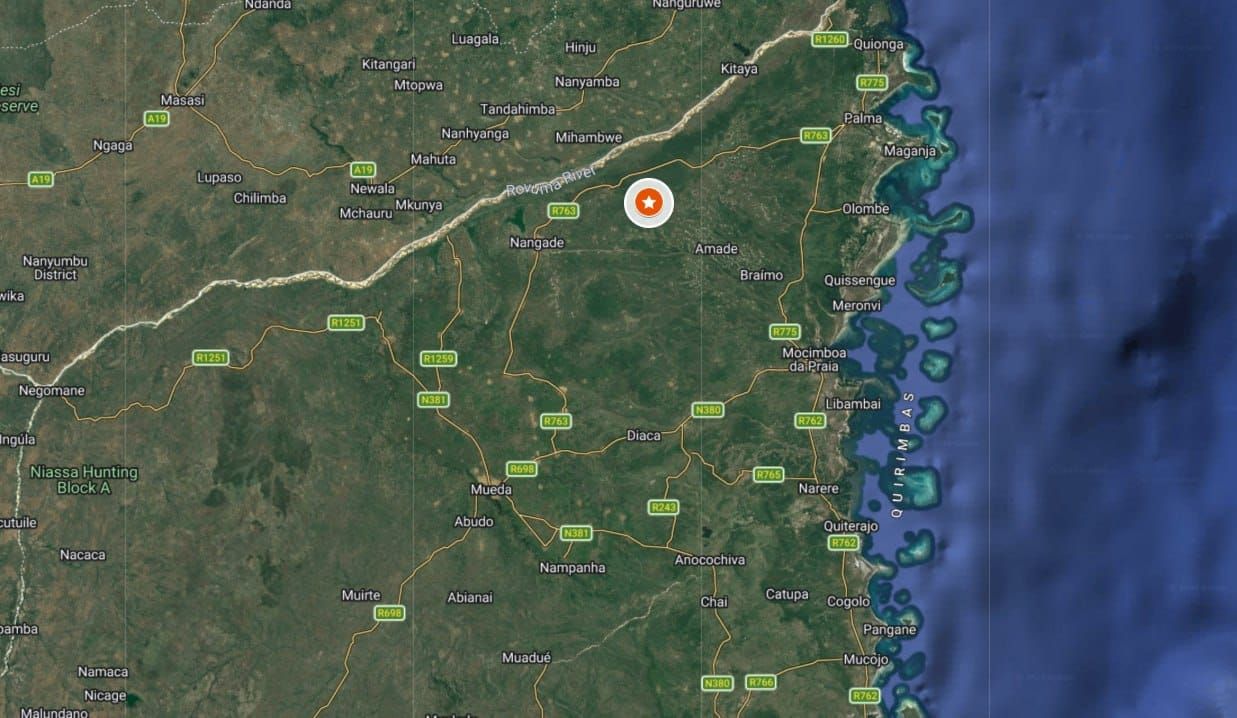
As forecast in our most recent Mozambique Conflict Monitor report, a group of up to 100 men made their way to the Ravia artisanal gold mining site in Meluco district, arriving on 20 April. The group spent up to six days at the site, according to a source. In the early morning of 26 April, militants, likely the same group, arrived at the Muaja artisanal gold mining site, about 30 km south of Ravia in Ancuabe district. According to a source, their arrival prompted miners and others to flee. Later in the day, a FADM detachment arrived and engaged the insurgents, but it soon withdrew. The militants then captured up to 80 miners, holding them for ransom of 50,000 meticais each (see map below).
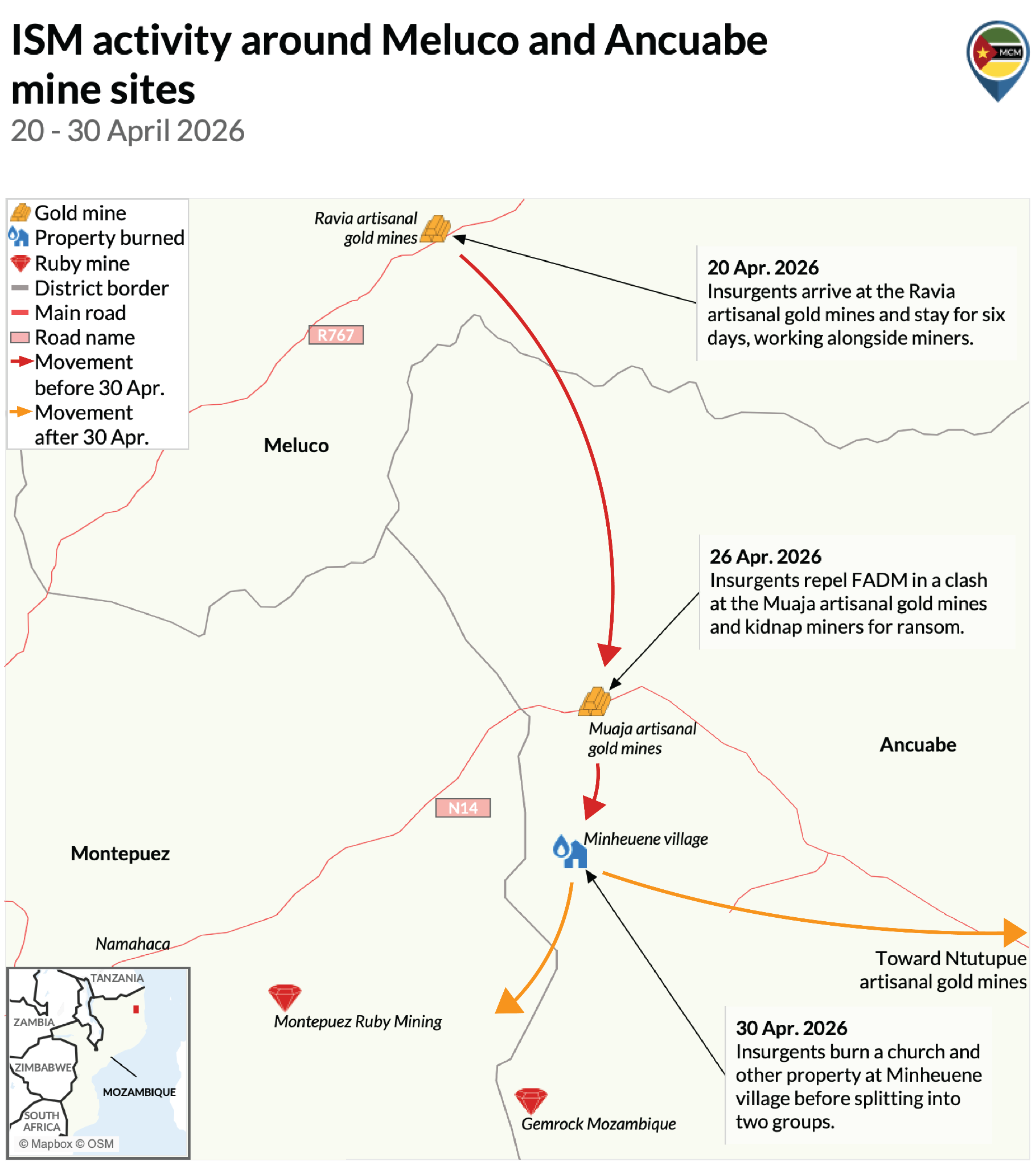
The group then moved further south to Minheuene village, where on 30 April they burned a Catholic church, a small school, and some church housing. There were no fatalities, most of the population having fled. The military arrived the following day to conduct searches in the surrounding area, a Minhuene resident reported.
According to a resident contacted by Zitamar News, 80 to 100 militants came to the village. They have now split into two groups, sparking further displacement. One group is said to be west of Minheuene, not far from the Montepuez Ruby Mining and Gemrock Mozambique mine sites. Following the Minheuene attack, Gemrock evacuated its staff from its mine site, which is approximately 16 km south of the town. The other is said to be at an artisanal gold mining site near Ntutupue, over 50 km east of Minheune, close to the N1 highway to Pemba town.
Focus: What does ISM want in Meluco and Ancuabe?
ISM’s current foray into southern Cabo Delgado tells us something about the relative importance of gold and religion to the group. Militants took over two mining sites seeking gold and money, and have since moved to a third. They also destroyed a church in Minheuene. Archbishop Inácio Saúre condemned the destruction at Minheuene, saying it sent “clear and strong messages of hatred against Christians.” These messages will likely be amplified with images of the church in the coming days through IS media channels, such as al-Naba, published on Thursdays. However, activities at mining sites were clearly of greater importance to the group.
From recent activity, we have learned three things about the group’s relationship with gold. First, we see that gold remains a significant source of income for ISM. The group’s activities around artisanal gold mining sites increased exponentially in 2025. Their recent activity at the Ravia and Muaja mining sites indicates that gold remains a strategic concern for the group.
Second, ISM’s actions at the Ravia artisanal mines suggest the group can get gold to market itself and is not solely reliant on cash payments from miners. According to a source in the artisanal mining sector in the province, while at Ravia the group was involved for some days in milling sand and gravel in order to extract gold ore. ISM can likely trade the gold it mines through Mozambican channels connected to overseas elements of the value chain, which reach as far as the United Arab Emirates and Turkey.
ISM took a markedly different approach in Muaja, indicating that the quality of its relations with miners varies from site to site. In Ravia, ISM was able to actively engage in mining for some days. It is unclear if this indicates that ISM exercises coercive control over the miners, or if they collaborate. In Muaja, meanwhile, the militants forced miners and other workers to flee from the site, before clashing with FADM troops stationed near the mine and kidnapping mine workers for ransom.
For the state security apparatus, these incidents imply a need for improved intelligence gathering and more timely incident response. For community leaders, much work will need to be done to shore up interreligious relations in the wake of the Minheuene attack. Large-scale commercial miners will, in the short term, need to intensify intelligence gathering, strengthen relations with state forces, and reevaluate risks to workers.
Roundup
China and Mozambique strike deals on critical minerals and security
China and Mozambique have agreed to map major untapped deposits of critical minerals in the country’s north, following talks between President Xi Jinping and President Daniel Chapo in Beijing on 21 April 2026. The joint geological survey will target high-value resources such as graphite, lithium, and rare-earth elements — minerals seen as vital for the global transition to clean energy. Alongside the minerals agreement, the two countries also strengthened security ties. Under a new memorandum of understanding, China will support Mozambique’s counter-terrorism efforts through expanded military and law enforcement collaboration. The agreement includes training for personnel, as well as the provision of equipment, technology, and joint exercises.
Mozambique flags used fraudulently by oil tankers
At least 10 oil tankers have been operating under fraudulent Mozambican registration, the country’s Maritime Transport Institute (Intrasmar) has reported. According to Unaite Mustafa, head of Intrasmar, the vessels include the Deyna, which is suspected of being linked to a Russian “shadow fleet” used to bypass international sanctions. Mustafa said the ships were using falsified documents and unauthorized websites to pose as officially registered under Mozambique’s flag. The case has been referred to the attorney general’s office for investigation.

)