
By the Numbers
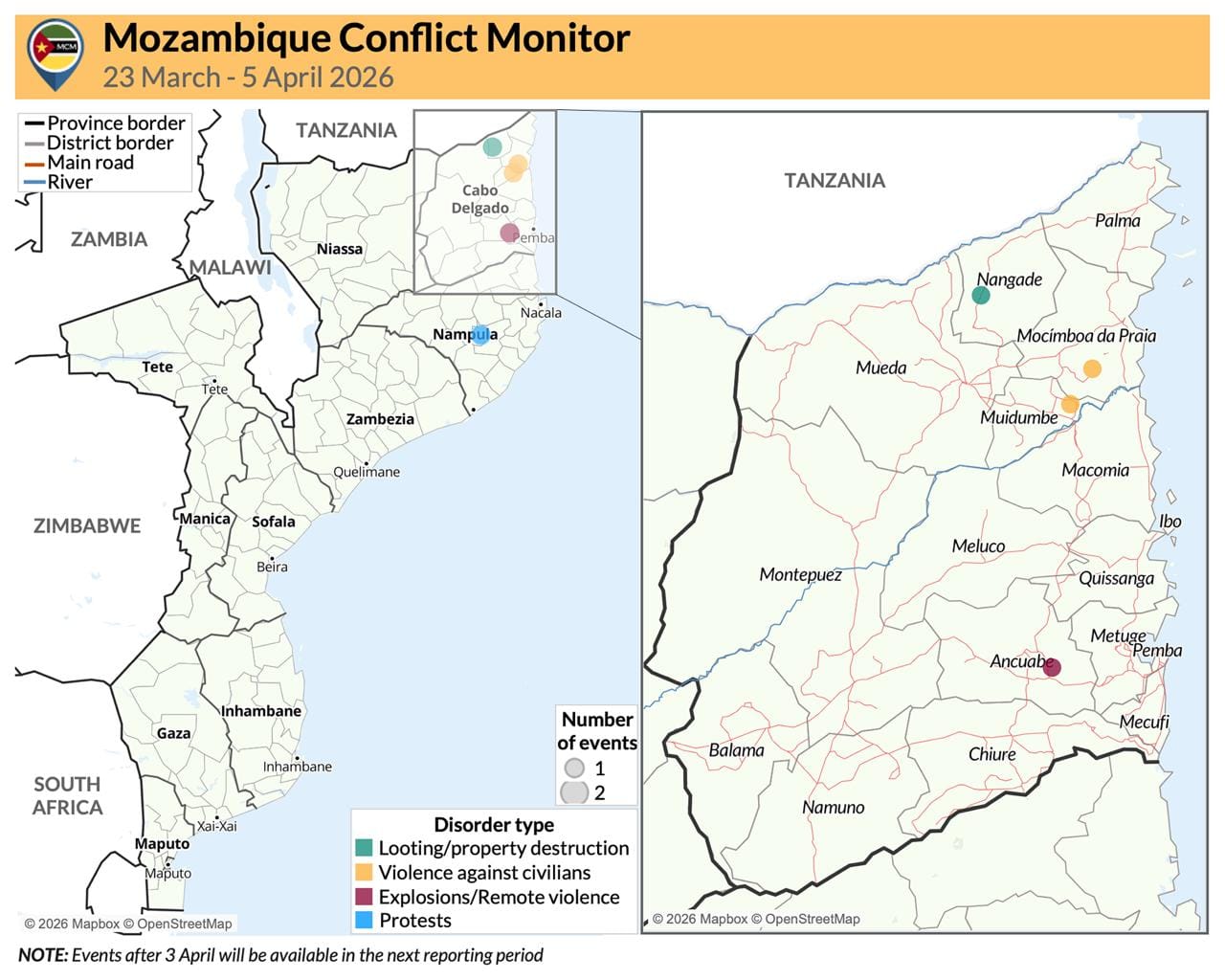
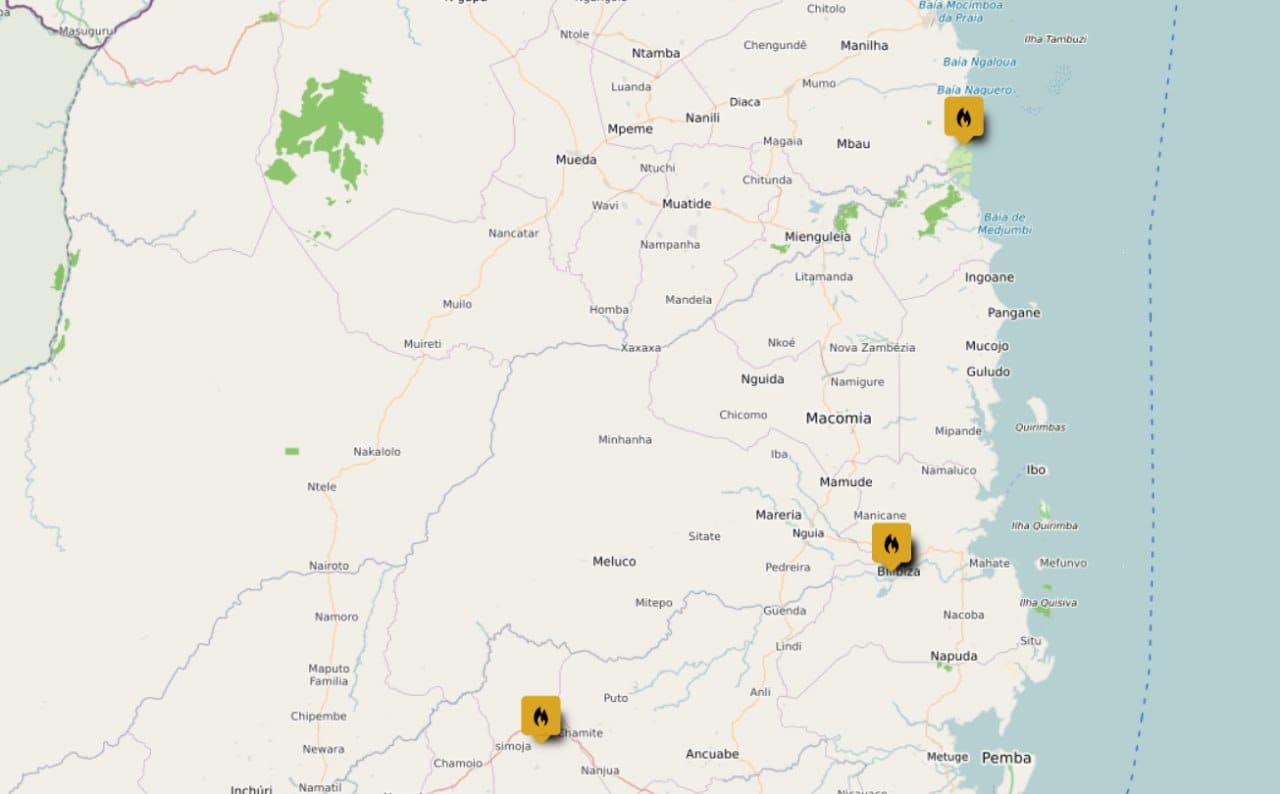
Data highlights in Cabo Delgado province (23 March - 5 April 2026)
At least 3 political violence events (2,345 in total since 1 October 2017)
At least 3 total reported fatalities from political violence (6,518 since 1 October 2017)
At least 3 reported civilian fatalities (2,735 since 1 October 2017)
At least 2 political violence event involving ISM across Mozambique (2,174 since 1 October 2017)
Overview
The past two weeks have been quiet. Islamic State Mozambique (ISM) has maintained a presence in Macomia and visited mine sites in Meluco, likely for extortion purposes. On the coast, the Defence Armed Forces of Mozambique (FADM) navy continues to patrol, seeking to block the mouth of the Messalo river, though relations with communities remain tense after the 15 March killing of fishers. In the political sphere, Rwandan President Paul Kagame has challenged oil companies and the Mozambican government to pay for Rwanda’s military presence or face withdrawal.
Situation summary
ISM maintains Macomia presence
Despite recent operations by Mozambican and Rwandan forces in Catupa forest, ISM maintains a presence in Macomia and Muidumbe district on both sides of the Messalo river. On 31 March, a group of up to 30 militants, according to one source, attacked a group of fishers at Nguri lake in Muidumbe district. The insurgents had come to the area by boat, moving along the Messalo river from the coast. According to a separate source, they have been unable to return to the coast, their boat having been swept away.
According to another source, a separate group of insurgents remains in northern Macomia district on the southern side of the Messalo river, presenting a threat to Chai and environs.
Insurgents visit mine sites in Meluco
South of Macomia district, a large group of insurgents visited gold mine sites at Minhanha and Ravia on 30 and 31 March. They first visited Matandane mine at Minhanha, approximately 30 kilometers north of Meluco town, where one source said there were over 100 militants. According to another source, the militants said they intended to attack Macomia town soon. The following day, they appeared at the Ravia mines, approximately 30 km southwest of Meluco. In the following days, they moved back northward. The group was likely extorting artisanal miners at both locations, for either cash or gold, an increasingly important source of income for ISM.
Clash heard near Silva Macua
Further south, on the morning of 1 April, people heard gunfire coming from forests between Silva Macua and Metoro. In the afternoon, they heard two rocket-propelled grenade bombardments and saw smoke. This prompted people in neighboring areas to flee to Silva Macua. Those fleeing could not say who was responsible for the gunfire and bombardments.
Suspected soldiers block road
An unidentified armed group stopped a vehicle near Litingina on 26 March and extorted money from those aboard, according to local sources. Litingina is on the main road, 18 km south of Nangade town. Locals believe members of FADM, which has a position less than 100 meters from the incident, are responsible. Sources disagree on the ownership of the vehicle. One said it belongs to a private company, while another said it belongs to a Mozambican nongovernmental organization.
Unfulfilled capulana promises spark violence in Nampula
Officers of the police Rapid Intervention Unit (UIR) fired on women demonstrating in the Anchilo area outside Nampula town on 4 April, injuring one. A child was also injured, reportedly trampled. According to reports, women were protesting Frelimo’s failure to provide them with capulanas, as had been promised by Gueta Chapo, the president’s wife, ahead of the 7 April Women’s Day holiday. Protesters vandalized a Frelimo office and blocked the N1 road running to Nampula. The intensity of the protests suggest that the women were motivated by more fundamental grievances. Gueta Chapo’s statement on 2 April that capulanas are in the shops, and that she does not own the factories, could only have exacerbated their frustrations.
Focus: State relations with coastal communities remain tense
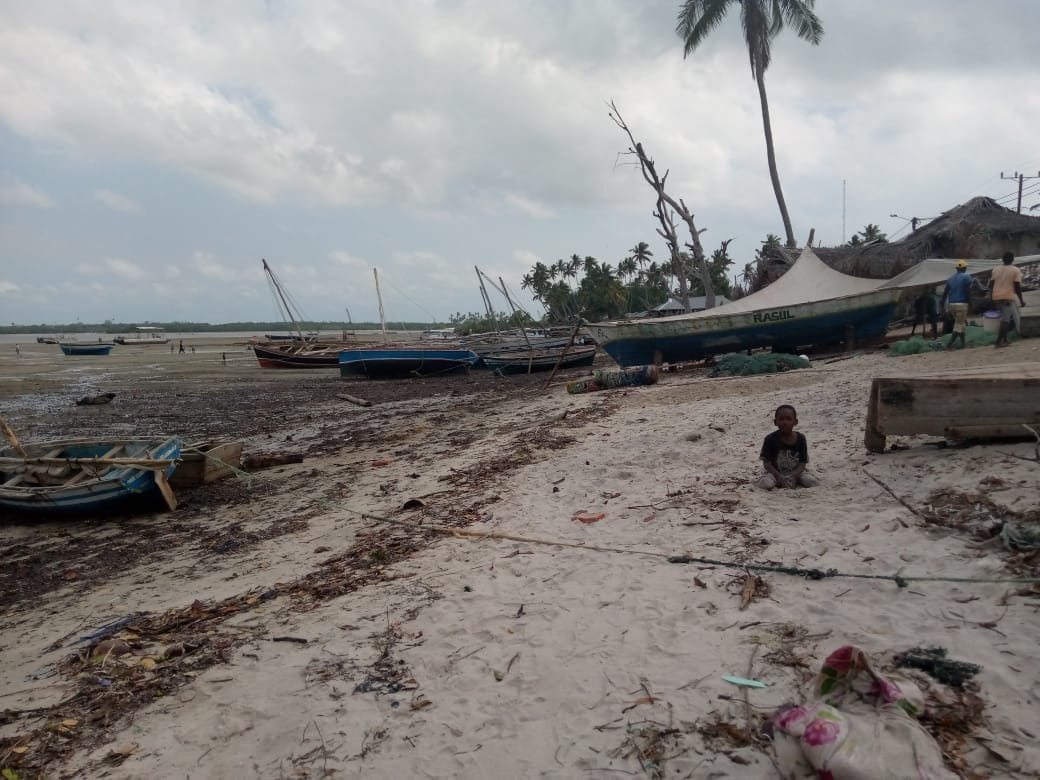
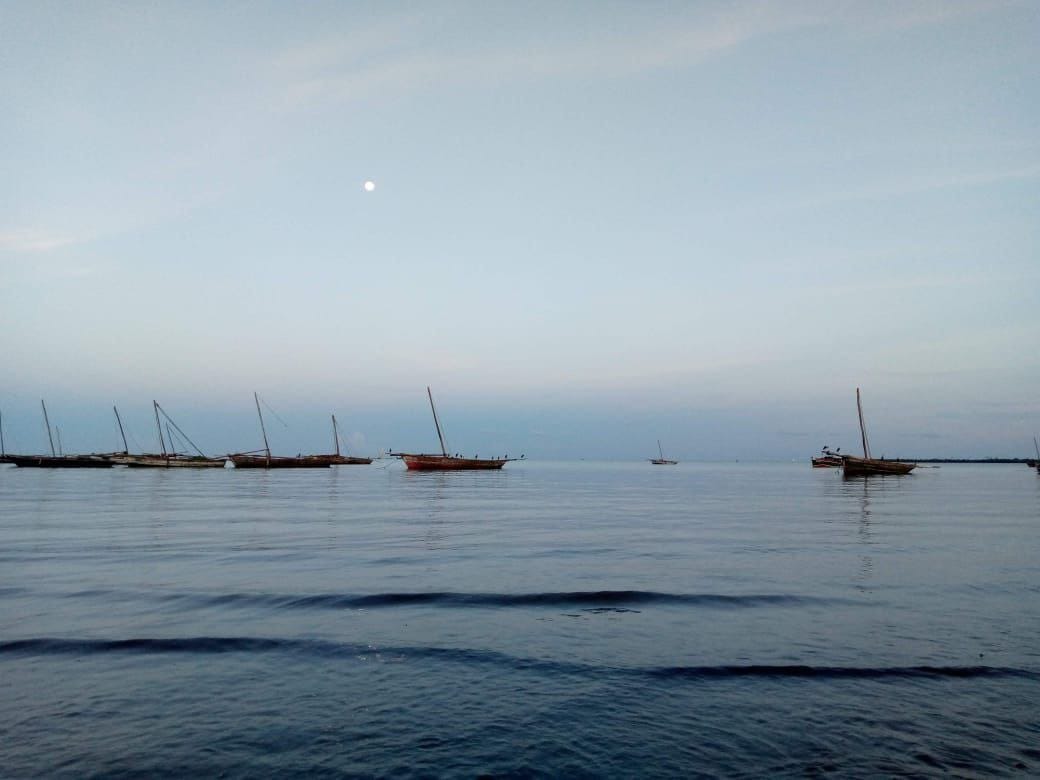
Since the 15 March killing of at least 13 fishers off the coast of southern Mocímboa da Praia, FADM appears to be pulling back, for now, from its confrontational approach to any sea traffic, whether civilian or ISM. According to a source in Mucojo, daily FADM navy patrols continue along the Macomia coast. The patrols engage civilly with fishers they encounter, warning them to go further north than Pequeue on the coast and Mejumbe island, saying there are ongoing operations. North of Pequeue and Mejumbe (also known as Dejumbe) lies Quiterajo, which has remained outside the state’s control for some time.
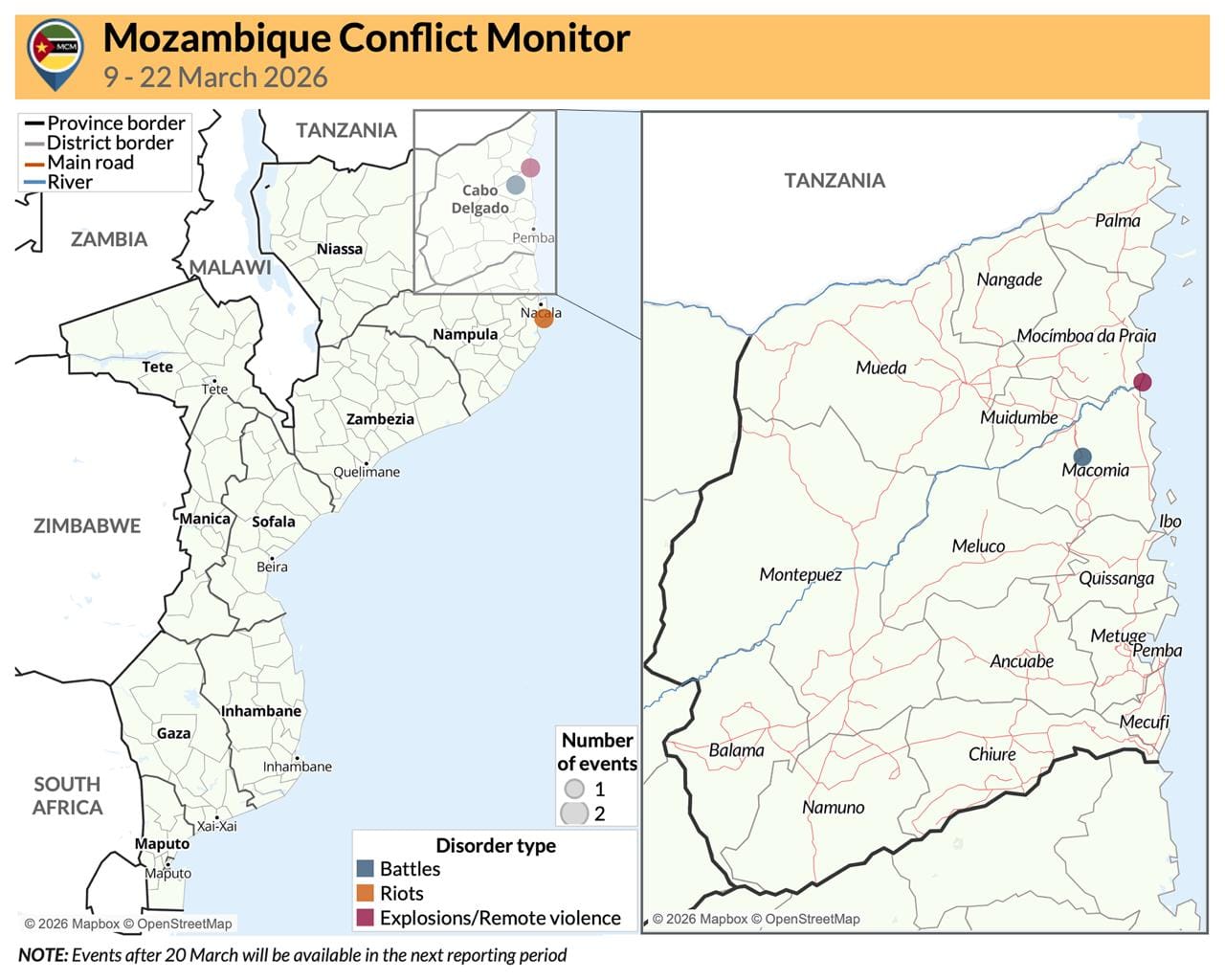
The FADM navy’s principal concern is with ISM’s use of the Messalo river as a route to and from their operational areas inland. Calugo, where the 13 fishers were killed, lies less than 10 km north of the broad, mangrove-dotted mouth of the Messalo river. Countering ISM on land and sea in Mocímboa da Praia and Macomia requires a more fundamental shift in approach. FADM’s apology for the 15 March killings, delivered at a public meeting in Mocímboa da Praia, was, according to witnesses, not part of the agenda, but a response to the discontent that FADM officers encountered at the meeting.
Further south on the Macomia coast, reports of a possible withdrawal of Rwandan forces raised concerns. The Rwandan Defence Force (RDF) assured locals that no pullout is planned, and that any future withdrawal would be well-signaled. Rwandan forces remain the preferred point of contact for the community in Macomia. On 29 March, four people who had left ISM, three men and a woman, appeared in the Mucojo area. Residents took them to the Rwandans where, according to a source, they can expect to be treated well.
Roundup
Kagame threatens to withdraw troops from Mozambique
President Paul Kagame has called on the government of Mozambique, TotalEnergies, and Exxon to “figure out how to pay for the security they need,” estimated at 100 million US dollars per year. In an interview with Jeune Afrique published 3 April on YouTube, Kagame said Rwanda could “pack our bags and go” if security is not needed. Rwanda has over 6,300 personnel, mostly RDF, but also police, according to government spokesperson Yolande Makolo.
Kagame’s remarks on Mozambique should be read in the context of the United States Treasury placing sanctions on the RDF, a connection made explicit by Minister for Foreign Affairs Oliver Nduhungirehe in March. In a 14 March comment on social media, he objected to seeing “our valiant soldiers being constantly questioned, vilified, criticised, blamed or sanctioned by the very countries that greatly benefit from our intervention in Mozambique."
Kagame’s ultimatum puts the companies and the US government in a difficult position. Companies working in extractive industries are required by US and European law to disclose payments to governments. Any payments to Rwandan forces are likely to be through the existing mechanism by which companies pay Mozambique’s finance ministry to support Mozambican forces deployed at the project site. If adopted, this could be interpreted as a means of avoiding sanctions and evading payment transparency requirements, potentially leading to significant reputational, political, and legal risks.
HRW calls for an urgent investigation into the killing of fishers by the Mozambican navy
Human Rights Watch (HRW) has called for a transparent and urgent investigation into the killing of at least 13 fishers off the coast of Mocímboa da Praia on 15 March, reportedly by Mozambican naval forces enforcing coastal restrictions. The organization also urged accountability and compensation for the victims. The incident occurred as part of efforts to restrict insurgent movement along the coast and highlights the continued risks faced by civilians whose livelihoods depend on fishing. HRW warned that such abuses could exacerbate local grievances and undermine broader counterinsurgency efforts.
UN faces major funding gap for humanitarian response in Northern Mozambique
The UN has appealed for $348 million to support 1.1 million people affected by conflict in northern Mozambique in 2026, but has secured only around one-third of the required funding. The response prioritises high-severity districts in Cabo Delgado, while also covering parts of Nampula and Niassa, and has already reached over 300,000 people with food aid and basic services. However, a widening funding gap — compounded by additional needs linked to recent flooding — is raising concerns about the sustainability of humanitarian operations in affected areas.
)