
By the Numbers
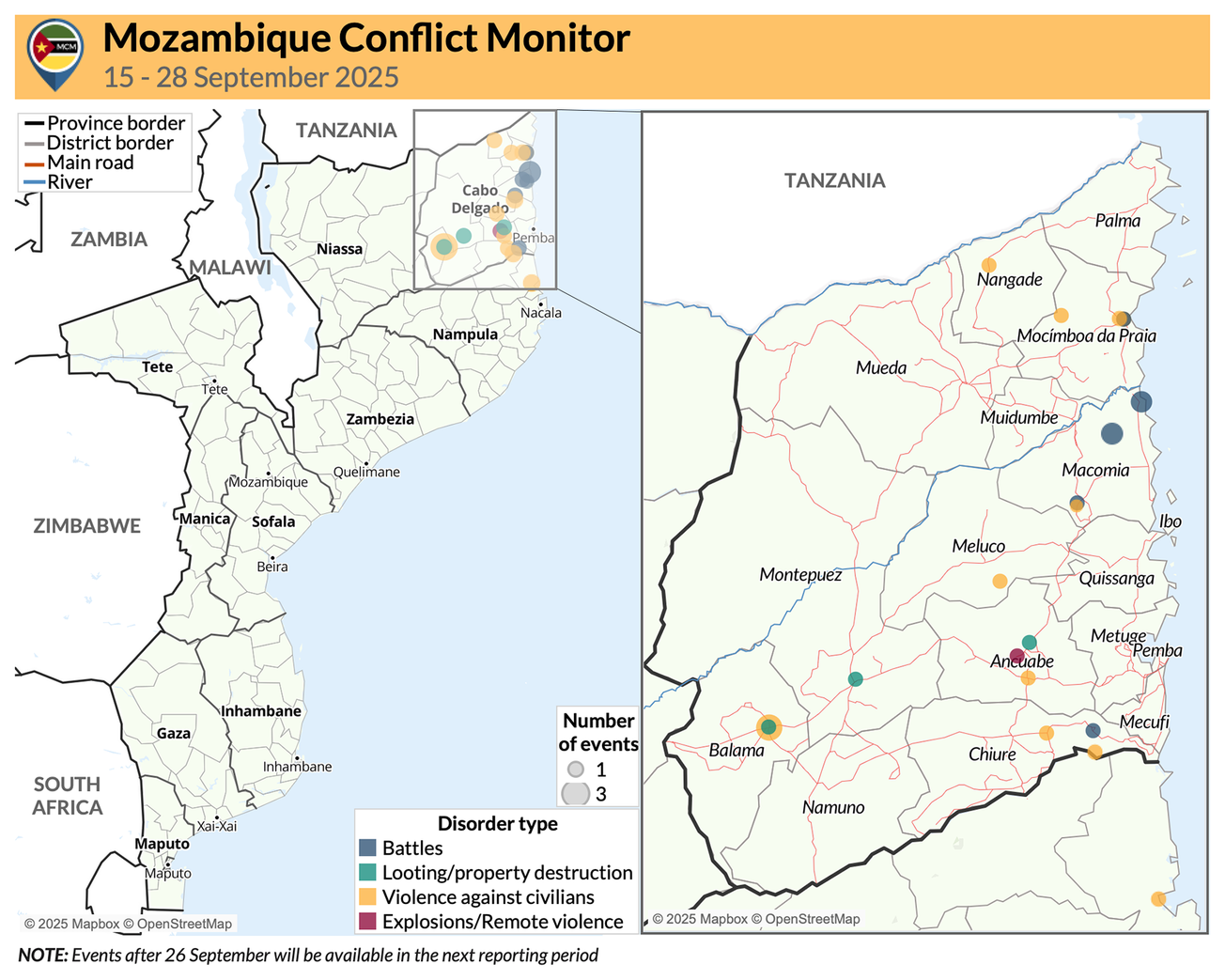
Data highlights in Cabo Delgado province (15 - 28 September 2025)
At least 19 political violence events (2,209 in total since 1 October 2017)
At least 21 total reported fatalities from political violence (6,257 since 1 October 2017)
At least 19 reported civilian fatalities (2,631 since 1 October 2017)
At least 19 political violence events involving ISM across Mozambique (2,035 since 1 October 2017)
Overview
Islamic State Mozambique (ISM) attacked three district towns in northern Cabo Delgado, while maintaining a presence in the province's southern and western districts. The most significant was ISM’s second attack in September on Mocímboa da Praia town, in which they killed five, contributing to tensions in the town. In the south, at least one group crossed into Nampula province at the end of September. Joint Defense Armed Forces of Mozambique (FADM) and Rwandan operations in Macomia may have contributed to ISM’s increasingly dispersed attacks.
Situation summary
ISM attacks three district headquarters
Between 22 and 28 September, ISM attacked the Mocímboa da Praia, Nangade, and Macomia district headquarters, killing at least nine civilians. In each incident, a small group of fighters targeted communities on the outskirts of the three towns under the cover of darkness. The attackers met resistance from state forces in Mocímboa da Praia only.
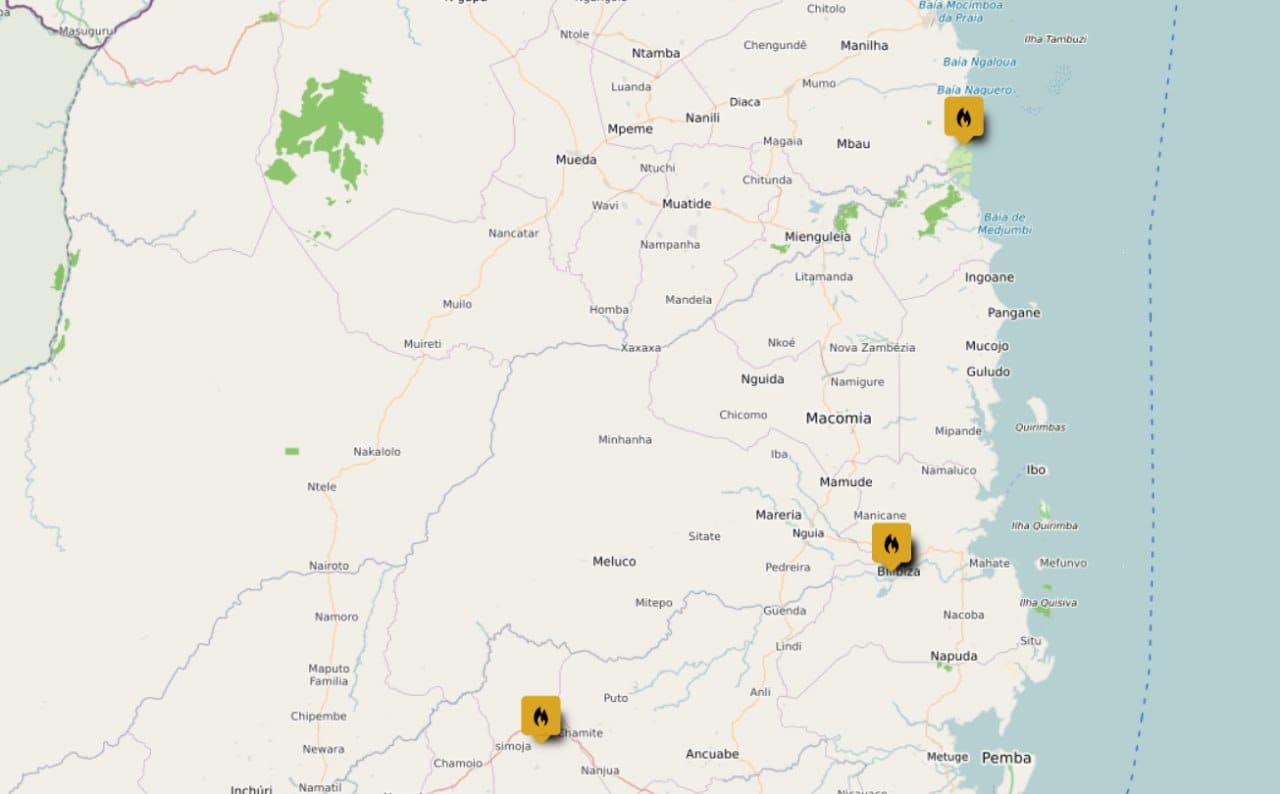
On 22 September, ISM entered the Filipe Nyusi neighborhood, moved from house to house, and killed five people — beheading four men and shooting one woman dead. According to a local source, the group retreated once Rwandan forces fired two grenades at them. The attack followed an incident the previous day in Mitope village, about 10 kilometers west of Mocímboa da Praia, where, according to an Islamic State (IS) claim, insurgents killed one civilian. On 23 September, ISM entered Nangade district headquarters around 11 pm, where they looted a shop for food supplies. Three people were kidnapped to carry the goods, while one woman collapsed dead while fleeing. According to a local source, the group that attacked is trying to establish itself in an area called Mboi, where Mocímboa da Praia, Nangade, and Palma districts meet.
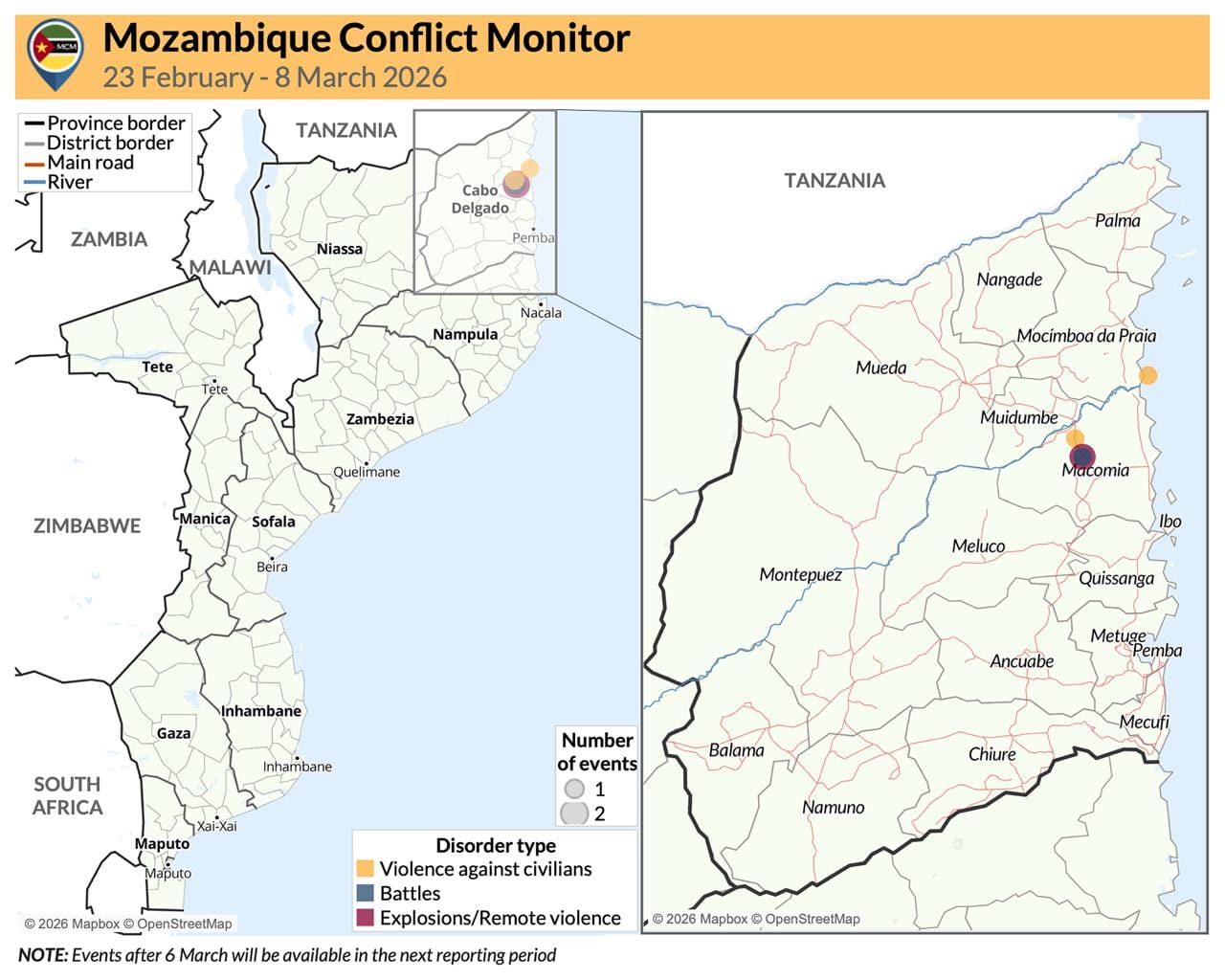
On the night of 28 September, ISM entered the Nanga neighborhood of Macomia district headquarters. According to local sources, they targeted the home of a Makonde businessman, where they killed at least four people, including a businessman known locally as Chibaba. The attackers kidnapped two adolescents before retreating.
FADM and RDF launch operation in Catupa forest
Following a deployment of troops from Macomia to the coast on 11 September, FADM and the Rwanda Defence Force (RDF) undertook significant operations against ISM in the Catupa forest area of Quiterajo. On 15 September, people in the Muidumbe lowlands first heard explosions coming from the southeast, according to a source in the area. These continued into the following day, when helicopters, likely RDF, were seen flying from Macomia town to the Quiterajo area. The operation resulted in residents fleeing, and it continued for at least two days with troops pursuing insurgents and conducting reconnaissance operations, according to a military source who spoke with the Lusa news agency. With the Macomia airstrip restricted to military traffic, FADM also strengthened its navy presence on the coast, while the Local Force was also deployed in the rear, according to a source.
On 19 September, two sources reported that an ambulance had left the coast and was heading to Macomia town. It was assumed to be carrying injured state forces, indicating that fighting had continued beyond 16 September. On 20 September, an ISM group was seen crossing Runho village, about 1.5 km from an RDF position, heading toward Quissanga. Some insurgents may have remained. On 20 September, a group of fighters clashed with a joint FADM and RDF patrol. IS issued a claim for the incident the following day, placing it at Namaneco, south of Quiterajo town. Three days later, on 23 September, ISM claimed to have killed two soldiers in a clash in the Catupa forest.
ISM still active in Balama and Montepuez districts
ISM remained active in both Balama and Montepuez districts, with IS claiming attacks on five villages in which two people were killed. Almost 100 ISM fighters have been in the area since the end of August. With much of Montepuez sparsely populated, it has concentrated its activities in informal gold mining areas west of Nairoto, with forays to Balama district.
In Balama, the group claimed three attacks, though only the one on Monapo village on 19 September could be geolocated. The group then moved north into Montepuez where it attacked Lusaka village on 24 September. Around this time, some of the group commandeered two logging trucks and drove to the Nambatano mining area near Ntola, according to a source. However, some remained, attacking Mahepe village west of Lusaka where, according to IS, they burned a church and 23 houses. The attacks in Balama caused over 2,100 people to flee, according to the International Organization for Migration (IOM).
Militants cross from Chiúre into Nampula province
In southern Cabo Delgado, another group of ISM militants was active in Meluco, Ancuabe, and Chiúre districts, and crossed the Lúrio river to Nampula province. The group of militants first attacked Mitope village on 15 September, according to an IS claim. Three days later, militants attacked Nonia village in Ancuabe district, where it burned some houses. Continuing south into Chiúre district, they moved through Ntique village, where a grenade they dropped was found by two children, according to local sources. The grenade exploded, the sources said, seriously injuring the pair.
ISM’s foray into Chiúre in July displaced around 50,000 people. Given the lack of reports of displaced people arriving in the district headquarters of Ancuabe and Chiúre, few if any have returned. ISM has likely been moving through mostly depopulated villages.
By 26 September, one group had reached Nacoja village on the Lúrio river, where IS claimed they killed one civilian and burned a church. Another group crossed the river into Nampula province, possibly at Namapa, over 40 km west, according to a Zitamar source. Reports emerging from Nampula are as yet unclear, but suggest that there have been some attacks on civilian communities in Erati and Memba districts, and that security forces have been deployed to the area. According to the UN Office for the Coordination of Humanitarian Affairs (OCHA), Mozambican forces encountered a group of fighters in Nampula’s Erati district as early as 25 September, arresting one. In response, ISM killed one civilian, OCHA said, though it did not give the location of the two events. A local official also confirmed fighting in that area. The following day OCHA reported multiple abductions and burning of homes in Memba district. A local source confirms that insurgents appeared in the Chipene village in Memba. On 28 September, according to OCHA, the group attacked Pavala village in Memba, burning a school and a health center. According to a local government source, security forces arrived in Chipene administrative post, also in Memba district, the same day.
Focus: Mocímboa da Praia attack highlights tensions in the town
Though the two recent attacks on Mocímboa da Praia have been short-lived and restricted to the outskirts, their impact has been significant. After the 7 September attack, aid agencies restricted their activities in the district. Four days after the 22 September killings, Doctors Without Borders, the primary health services provider in the district, announced the suspension of its activities in Mocímboa da Praia. The agency’s misgivings are shared by the population. According to IOM, almost 1,500 people fled the town in the wake of the 7 and 22 September attacks and due to rumors of an upcoming attack on 5 October, which marks the anniversary of the first day of the insurgency in 2017. Most headed to Mueda. This is despite authorities attempting to stop people from leaving the town following the second attack, according to local sources.
Alongside fear of ISM, there is a significant element of distrust growing between authorities and communities in the town. In a 24 September meeting between district authorities and the business community, business leaders said they were moving their families out of town and feared losing both their businesses and their property. The account of the meeting came through Frelimo messaging channels in Mocímboa da Praia. Assuring them that they were safe, police District Commander Alberto Napova reportedly said that “there is evidence that the enemy is among us, but we report little. If we continue like this, the war may take its time to end.” Napova’s message echoed similar comments made by a Rwandan commander in the wake of the 7 September attack.
Pictures accompanying the report also reflected the tensions between security forces and the community. As business leaders met inside with Helena Bandeira, the Nampula-based mayor of Mocímboa da Praia, and district administrator Sérgio Cipriano, dozens of young men squatted outside, guarded closely by RDF troops with automatic rifles and tear gas launchers.
An underlying tension may be that between the Mwani and Makonde communities. According to the Mozambique Times, the victims in the 22 September attack were Makonde, as were the victims in the recent attack in Macomia town. The neighborhoods in Mocímboa da Praia attacked recently have long had a predominantly Makonde population. The mainly Christian Makonde originally come from the Frelimo heartland of the Mueda plateau, where the liberation war against Portugal began, and have dominated Frelimo leadership, while coastal Muslim communities are primarily Mwani. It was likely such tensions that led District Commander Napova to stress in his remark that the insurgents come from a range of ethnic backgrounds.
Roundup
President Chapo opens the possibility for dialogue with insurgents
In a recent interview with Al Jazeera, Mozambican President Daniel Chapo described two strategies for addressing the ongoing insurgency in Cabo Delgado. The first is a military solution supported by Rwandan and Tanzanian forces. Chapo also suggested the possibility of opening a dialogue with the insurgents to resolve the conflict, pointing to historical examples such as Mozambique’s struggle for independence and its 16-year civil war, both of which ended through negotiations. He added that the government could explore ways to identify the insurgent leadership and their motivations to facilitate peace talks.
Authorities detect $7 million of suspicious financing linked to “terrorism”
The Mozambican Financial Intelligence Office has identified more than 458.6 million meticais (around 7 million US dollars) in “terrorist” financing in Cabo Delgado between 2017 and 2024. According to the office, this financing involves the deposit, withdrawal, and transfer of small sums. The aim is to conceal activities within the banking and mobile financial services systems. Those suspected of involvement include traders, civil servants, members of NGOs, and private companies — mainly from Cabo Delgado, Niassa, and Nampula — as well as individuals from countries in southern, central, and eastern Africa that are affected by “terrorism,” according to the report”
“Everything ready” for Mozambique LNG project restart
TotalEnergies CEO Patrick Pouyanné told investors in New York on Monday that “everything is ready” for a full restart of the Mozambique LNG project, which has been formally suspended under a force majeure declaration since an attack on the town of Palma in March 2021. His words lend weight to a report in respected industry publication Upstream that said the decision on lifting force majeure would be announced on Thursday, 2 October. Pouyanné confirmed reports that the project consortium and the Mozambique government still needed to approve an updated development plan and budget to account for the impact of the force majeure, Bloomberg reported. The chief executive of ExxonMobil, operator of another LNG project to be built next to TotalEnergies’, met with President Chapo in New York last week and sought assurances over security in the area, the Financial Times reported.

)