
By the Numbers
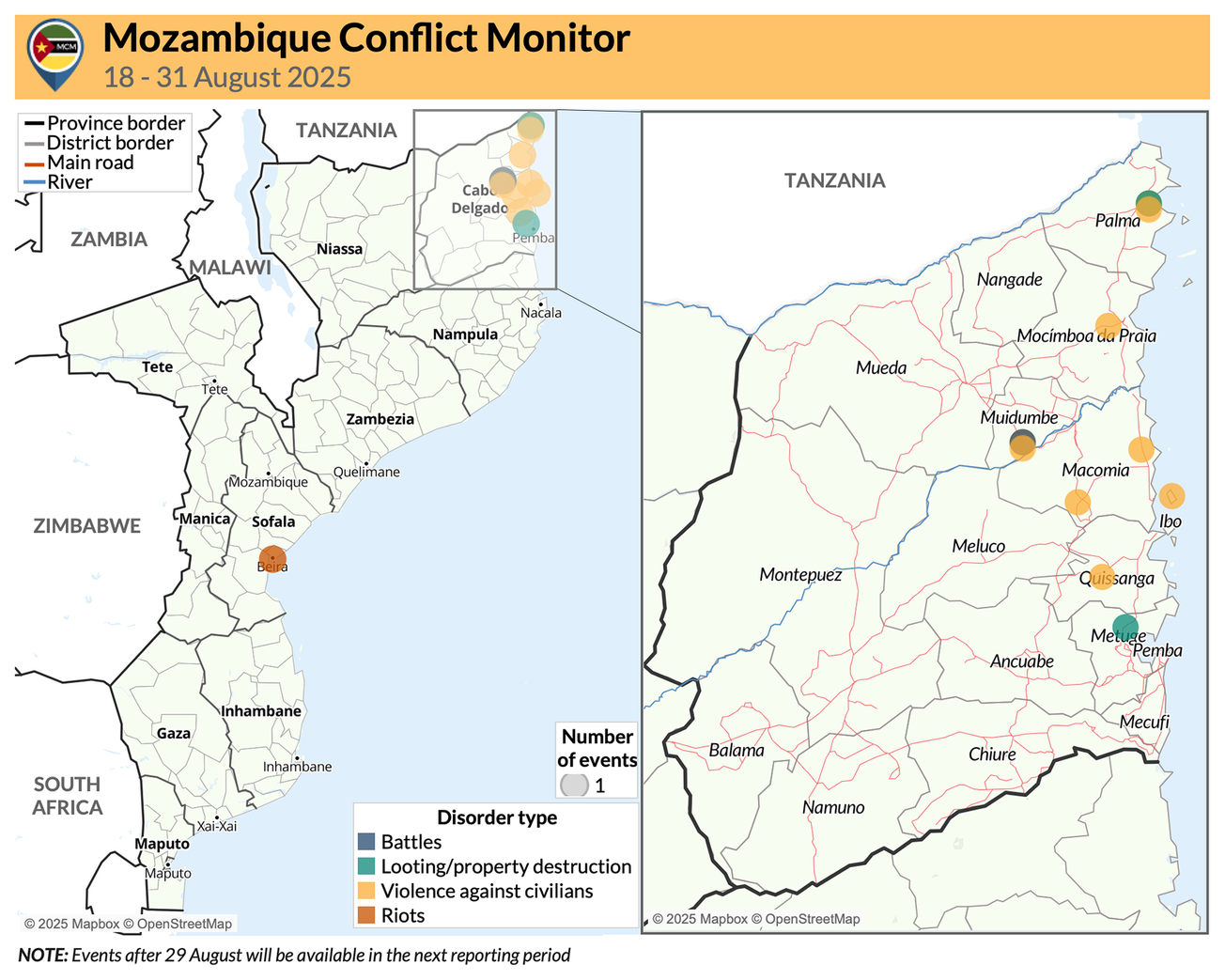
Data highlights in Cabo Delgado province (18 - 31 August 2025)
- At least 8 political violence events (2,173 in total since 1 October 2017)
- At least 20 total reported fatalities from political violence (6,188 since 1 October 2017)
- At least 12 reported civilian fatalities (2,568 since 1 October 2017)
- At least 7 political violence events involving ISM across Mozambique (1,999 since 1 October 2017)
Overview
Defense Armed Forces of Mozambique (FADM) navy patrols remain active off Macomia, killing at least five civilians around 22 August. Despite these patrols, Islamic State Mozambique (ISM) remains present in coastal areas of the district. In Palma district, ISM killed at least three civilians south of Palma town, where it has been active for at least three weeks. Stretching security cover, ISM fighters are also making their way westward along the Messalo river to Montepuez. Amid this activity, Rwanda and Mozambique signed a military agreement cementing Rwanda’s operation in northern Mozambique that is now over four years old.
Situation summary
FADM kills at least five civilians off Macomia
Soldiers on a FADM naval vessel opened fire on two civilian vessels near Pequeue in Macomia, killing at least five people around 22 August, according to multiple local sources. One vessel, named Real Madrid, was traveling north from Mefunvo island in Quissanga district to Pangane in Macomia district. FADM navy patrols are active in the area, operating out of Ibo island. This is at least the third such confirmed incident since the first week of July. A source in the area reports that another fishing boat from Pangane, named Mbaraca, was also shot at with an unknown number of fatalities. However, according to a spokesperson, FADM “categorically denies” any involvement in these incidents.
The attack comes amid ongoing ISM activity on the Macomia coast. On 19 August, ISM fighters were seen at Pangane, before moving onwards toward Quiterajo in a boat they hired at Mussemuco in the south of the district. On 24 August, ISM and FADM clashed at Quihanhune island, off the coast of Quiterajo. One source reported a clash, while another reported the seizure of explosives allegedly brought in from Tanzania.
Multiple sources have reported arrests and civilian targeting by the FADM navy between 21 and 27 August, although the individual events could not be confirmed. Given continued ISM activity, FADM may have determined that anybody at sea is ISM. Such an assumption would be misplaced. Coastal communities need to fish and bring in supplies by boat. Two sources indicated that the boat targeted on 22 August was carrying salt. ISM activity onshore also belies the assumption that the coastal community wholly supports ISM. On 22 August, ISM abducted a woman at Pangane who brews and sells alcohol, taking her away by boat. Four days later, ISM abducted a local official in Nagulue village, close to Mucojo, reportedly for collaborating with the security forces.
ISM remains active in Palma district
In Palma district, ISM remained active south of Palma town. On 23 August, about a dozen ISM fighters in FADM uniforms stopped a minibus that was travelling between Zambia and Olumbe villages, stealing from passengers. The Islamic State's weekly newsletter, al-Naba, published a picture of 11 passengers, with an ISM fighter addressing them. According to al-Naba, he spoke of “the purpose and goals of jihad… and the media’s lies about them.” The group then headed south, according to a source. Also on 23 August, ISM killed three civilians near the village of Hovlili, less than 10 kilometers south. The two actions are indicative of ISM’s current strategy of moving and operating in small cells, which conventional forces find difficult to counter.
Kidnap for ransom continues as ISM looks to raise money
South of Mocímboa da Praia town, a group of ISM fighters passed through Chimbanga village around 27 August, where they abducted two girls and looted goods. This is the fourth incident involving ISM fighters in the district in August.
Further south, in Quissanga district, ISM fighters returning from Ancuabe and Chiúre districts kidnapped at least 16 men at the fishing community on the shore of Bilibiza lake on 19 August. The militants demanded ransoms of between 10,000 and 15,000 meticais (150 to 230 US dollars).
ISM move toward Montepuez may stretch security forces
Reliable sources report that insurgents are moving toward Nairoto in Montepuez district. They started moving westward in small groups along the Messalo river before attacking Mapate village in Muidumbe district. There, on 25 August, they killed four civilians and burned almost 30 buildings, according to a claim that IS issued four days later. According to one source, the attack caused people in nearby Mandela and Mandava villages to flee. Two days later, the insurgents were seen near Homba in southern Mueda district. If the group continues its westward journey, it may threaten the R698 road that connects Montepuez town to Mueda. There is also a possibility that the group may continue further westward toward Niassa. In either case, if the security forces respond, their resources will be stretched.
Focus: Status of forces agreement signed with Rwanda
After more than four years in Mozambique, Rwanda finally signed a status of forces agreement (SOFA) with the host country on 27 August. Defense ministers Juvenal Marizamunda of Rwanda and Cristóvão Chume of Mozambique signed the document during President Daniel Chapo’s two-day visit to Rwanda. A SOFA provides an agreed legal framework for military operations between states. It governs all aspects of deployment, such as the importation, control and removal of arms and equipment, civil and criminal liability of foreign forces, management of bases, and operational relations with the host country.
There is no evidence that a SOFA was in place prior to 27 August. The timing of the SOFA was likely influenced by TotalEnergies’ efforts to restart the liquefied natural gas (LNG) project in Palma, suspended since 2021. The agreement may help reassure investors and regulatory bodies that the project is secure and has guardrails in place to ensure that the security response is respectful of human rights. Through official and proxy channels, Rwanda has focused on the level of security it can bring to Cabo Delgado. The Rwanda Defence Force (RDF) released a video on 29 August showcasing Rwandan forces’ actions at sea, on land, and in the air. One social media account regarded as a proxy for the Rwandan government floated the idea of Rwanda establishing a “permanent base” in Mozambique.
The RDF’s video may not reflect its actions. ACLED records RDF involvement in just 10 violent incidents thus far in 2025. ACLED research has demonstrated that Rwandan forces now adopt a conservative posture, even in areas where they have established combat outposts such as Macomia district. An unwillingness to aggressively engage with ISM can place civilians at greater risk of attack. Though Rwanda has troops positioned at Mucojo on the coast, at Chai on the N380, and near Ancuabe town in the south, this posture is unlikely to change under the SOFA. This is seen most clearly in coastal Macomia, where FADM, rather than Rwandan forces, has taken the lead in combat on land and at sea.
Roundup
CPJ and MISA Mozambique call for investigation into disappearance of two journalists
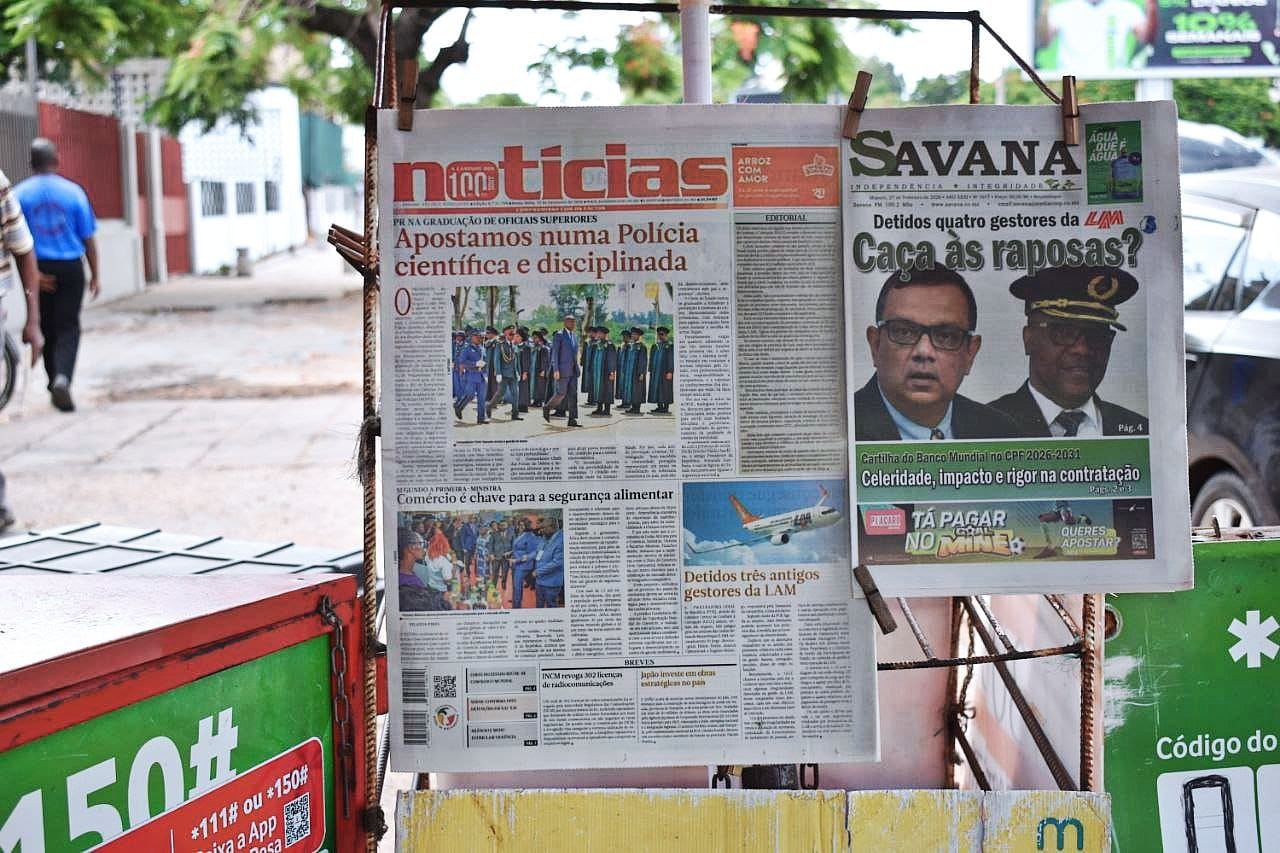
In preparation for the International Day of the Victims of Enforced Disappearances on 30 August, the Committee to Protect Journalists (CPJ) and MISA Mozambique urged the Mozambican authorities to clarify the fate of two missing journalists, Ibraimo Abú Mbaruco and Arlindo Chissale. The two reporters disappeared in similar circumstances in Cabo Delgado. Mbaruco, a reporter for Palma Community Radio, disappeared on 7 April 2020 after texting a colleague to say that he was “surrounded by soldiers.” Chissale, editor of Pinnacle News, was abducted on 7 January 2025 by men, some of whom were wearing military uniforms, from a minibus in Silva Macua. Chissale had previously been arrested in 2022 and warned that he was on a “target list” after criticizing the ruling Frelimo party’s alleged electoral fraud in 2024. His family understands that he is no longer alive. The CPJ and MISA Mozambique have condemned the government’s inaction, highlighting the unsafe environment for journalists and raising concerns about military involvement in these unresolved disappearances.
Cabo Delgado authorities halt community radio revival
On July 22 2025, the provincial government in Cabo Delgado revoked the authorization granted to the National Forum of Community Radios (FORCOM) on 17 February to install equipment for Mocímboa da Praia Community Radio. This was despite the national government information office, known as GABINFO, issuing an operating license in November 2024. According to the provincial authorities, this decision was made because FORCOM lacks formal ties to any centrally managed reconstruction plan. FORCOM installed the equipment at the radio's original site in May 2025.
FORCOM contests the revocation, asserting that it had complied with all legal requirements and had not been informed of any changes regarding the building's use. FORCOM views the decision as a violation of press freedom and suspects that it is an attempt to transfer the radio’s frequency and ownership to the state-run Institute of Social Communication (ICS). That the case was not reported until mid-August illustrates the need for a stronger media presence in Cabo Delgado.

)