
By the Numbers
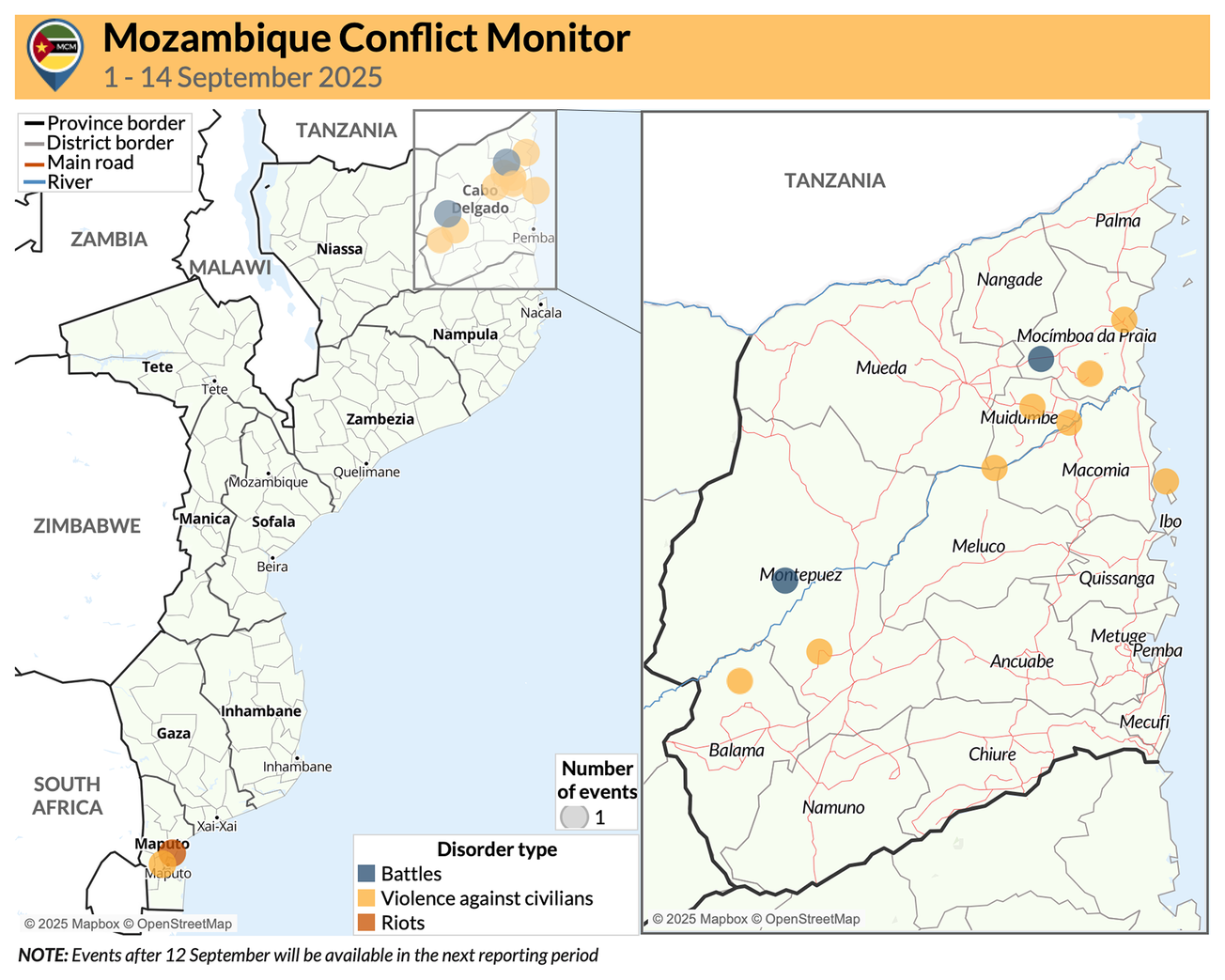
Data highlights in Cabo Delgado province (1 - 14 September 2025)
- At least 9 political violence events (2,185 in total since 1 October 2017)
- At least 21 total reported fatalities from political violence (6,215 since 1 October 2017)
- At least 20 reported civilian fatalities (2,594 since 1 October 2017)
- At least 9 political violence events involving ISM across Mozambique (2,011 since 1 October 2017)
Situation summary
ISM enters Mocímboa da Praia
On 7 September, a small group of ISM fighters killed at least four civilians in Mocímboa da Praia’s 30 de Junho neighborhood, fewer than 2 kilometers from the town’s airport. According to one report, fighters went door to door to identify victims. It is unclear if they were doing so on the basis of religion or ethnicity, though District Administrator Sérgio Cipriano said that the attackers asked for people by name. Neither Mozambican nor Rwandan security forces responded directly to the attack, though the Rwandan forces’ Mozambique headquarters are less than two kilometers from the 30 de Junho neighborhood.
ISM was active elsewhere in Mocímboa da Praia district. On 5 September, a group of fighters clashed with a FADM patrol near Diaca, over 40 km west of Mocímboa da Praia town. IS issued a claim for the incident the following day. On 12 September, IS issued a claim for the killing of one civilian in Mbau, further south in Mocímboa da Praia district. As a result of the attacks, over 1,700 people fled Mocímboa da Praia for Mueda, Palma, and Montepuez, according to the International Organization for Migration (IOM).
FADM navy shootings continue
Macomia district and its coastal waters remain unstable. On 8 September, a FADM navy patrol killed at least 16 people, believed to be civilians, at Rolas island, off Macomia but part of Ibo district. Local sources say that a group of people had moved to Rolas from Matemo to set up a fishing camp, and that a navy patrol from Ibo approached the island and opened fire on all there.
This is the third consecutive month in which the FADM navy has opened fire on civilians off the Cabo Delgado coast. Around 22 August, FADM killed five fishermen near Pangane. The previous month, at least three civilians died in a similar incident near Pangane village. According to FADM spokesperson Colonel Benjamin Chabualo, the reports from Rolas island were “false.” Cabo Delgado Governor Valige Tauabo said on 13 September that he “did not yet have all the data,“ almost a week after the incident. Though he had planned to visit that day, his trip was postponed. Nevertheless, authorities seem to be concerned. Mozambique Conflict Monitor understands that since the shooting, naval patrols in the area have greatly reduced.
The killings prompted some seasonal fishermen from Nampula to leave the area. Among them were 16 young men who took a truck in Macomia town but were arrested by police in Metoro, in Ancuabe district, on 12 September on suspicion of being insurgents. According to a local source on the coast, they took a bus from Pangane to Macomia before getting a lift in the truck in which they were found. They remain in detention in Pemba.
Two days after the Rolas killings, on 11 September, at least 10 Rwandan trucks were seen moving toward the coast, though there have been no reports of clashes in the area since their arrival. One day before the Rwandan forces moved east, on 10 September, shots were heard in Macomia town, prompting some to move to the bush, according to sources in the town. For at least four days before that, there had been an ISM presence to the south of Macomia, contributing to tensions in the town.
ISM clashes with FADM in Montepuez
As predicted in the most recent Mozambique Conflict Monitor, the group of up to 90 insurgents who had been heading west along the Messalo river finally reached the Nairoto Administrative Post area around 31 August. Arriving first in Nacololo village, they continued south toward Ntola, a village close to several artisanal gold mining sites. They stayed in that area until 10 or 11 September, according to local sources. FADM forces were dispatched to the area. ISM ambushed an initial force near Ntola on 7 September. According to a statement issued by IS, there were no fatalities in the attack. ISM attacked at least one village in Montepuez on 10 September. The village, Nquewene, lies approximately 15 km west of Ntola.
IS also issued a claim for an attack at Mavala village on 12 September, where, according to the claim, they captured and killed one person, likely male. Though ISM’s claim said the attack occurred in Montepuez, Mavala lies in Balama district, approximately 30 km north of Balama town, and 50 km west of Montepuez district headquarters. FADM has clearly been stretched by ISM’s push into Montepuez and now Balama. Mozambique Conflict Monitor records just one engagement between the two forces while ISM has been there.
People flee ISM in Muidumbe and Meluco lowlands
ISM continues to maintain a presence in the lowlands of southern Muidumbe and into Meluco districts since its attack on Mapate village on 25 August, during which insurgents killed five civilians. On 3 September, the group carried out an attack and killed four civilians in Xaxaxa village in Meluco, just across the Messalo river that separates Muidumbe and Meluco. On 7 September, they entered Miangalewa village on the N380 and killed a young man. Originally from the village, he had been visiting from Nampula to buy fish. Around 11 September, the group was seen moving across territory closer to Mapate village again, south of the main road running into the Muidumbe lowlands. Residents of the district headquarters, Namacande, as well as people in neighboring villages spent nights sleeping outside, according to various sources. According to IOM, over 2,000 people fled their homes in Muidumbe district due to attacks, or fear of attack, between 25 August and 11 September.
Focus: Residents question response to Mocímboa da Praia attack
If ISM’s attack in Mocímboa da Praia’s 30 de Junho neighborhood on 7 September was planned to create uncertainty and division in the minds of residents and authorities, it was a success. Given the rate of ISM activity in Mocímboa da Praia district, it should not have come as a surprise and indicates a considerably heightened risk of further attacks.
The 7 September attack was only the second by ISM in Mocímboa da Praia town since September 2021. On 31 August last year, a group of up to 10 ISM fighters clashed with a Rwanda patrol in the town. ISM violence in Mocímboa da Praia district in 2024 was more than double that of the previous year. The rate of activity in the district this year is not quite as high, but it had almost met 2023 levels by mid-September.
The population’s response to this year’s attack has been quite different from last year. Demand to leave the town has been enough to drive up the price of a Mueda bus ticket by two-thirds. The unease is also seen in relations between residents and authorities, and in particular with the Rwandan forces. On 10 September, the district administration called a meeting with public officials and community leaders, which was also attended by a Rwanda Defence Force commander. According to a statement circulated by local Frelimo officials, the commander told those gathered that despite the advantages state forces have, “eliminating a small group of bandits within a short radius” remains a challenge. He went on to suggest that the insurgents were receiving support within the community.
The following day, 11 September, authorities called another public meeting to discuss the situation, which turned into a peaceful protest as people refused to speak with representatives of the Mozambican security forces present. On a video clip of the protest in circulation on social media, a person is heard saying that they will only speak with Rwandan forces. In another lengthy voice note recorded after the protest, also in circulation on messaging apps, a woman argues that attendees wanted to speak with the Rwandans not because they favored them, but because Rwandan forces had failed to respond to the community’s reports, and attendees wanted to voice their complaints directly.
Neither Rwandan forces nor FADM responded promptly to the 7 September attack, allowing ISM to escape. ACLED has documented a similar reluctance by Rwandan forces to respond to ISM actions in Macomia district. Such a lack of response in urban areas may quickly diminish the reputation for effectiveness that Rwandan forces have developed and weaken communities’ trust in them. As the demonstration on 11 September showed, it also has very real political implications for Mozambican authorities and may create openings for further attacks.
Roundup
OCHA laments declining humanitarian assistance
The United Nations Office for the Coordination of Humanitarian Affairs (OCHA) says that humanitarian responders have reached just over 70% of the people in Cabo Delgado they had hoped to assist in the first seven months of this year. OCHA says the response has received just 66 million US dollars of its $352 million requirement. It has now prioritized the districts of Macomia, Muidumbe, Nangade, and Quissanga. Funding challenges aside, the conflict makes these the most difficult areas to reach.
New commander for Rwandan forces in Cabo Delgado
Rwanda is preparing to rotate out its security forces in Cabo Delgado, with a new contingent coming in under the command of Major General Vincent Gatama. At a briefing ahead of their deployment, the incoming troops received a message from Rwandan President Paul Kagame, in which he emphasized the importance of maintaining the discipline and momentum demonstrated by the Rwandan security forces in Cabo Delgado over the past four years.
Marshall Samora Machel Academy holds inaugural congress on Cabo Delgado
On 11 September 2025, the Marshall Samora Machel Academy, a military academy in Nampula, held its first one-day academic congress, with a focus on the Cabo Delgado conflict. One study, which analyzed insurgent activities in Cabo Delgado from 2017 to 2024, emphasized the Mozambican state's institutional weaknesses in remote areas, resulting in limited access to essential services and employment opportunities. This absence hampers intelligence-gathering efforts, according to the study.
Another study highlighted budgetary asymmetries that may undermine the reputation of Mozambican armed forces. Despite successes, such as reclaiming areas like Mocímboa da Praia and reducing insecurity, the study suggests that the disparity between Mozambique’s limited defense budget and Rwanda’s externally funded support poses a challenge to the legitimacy of Mozambican forces.

)