
By the numbers
Data highlights in Cabo Delgado province (4 - 17 August 2025)
- At least 17 political violence events (2,162 in total since 1 October 2017)
- At least 9 total reported fatalities from political violence (6,165 since 1 October 2017)
- At least 6 reported civilian fatalities (2,554 since 1 October 2017)
- At least 16 political violence events involving ISM across Mozambique (1,988 since 1 October 2017)
Overview
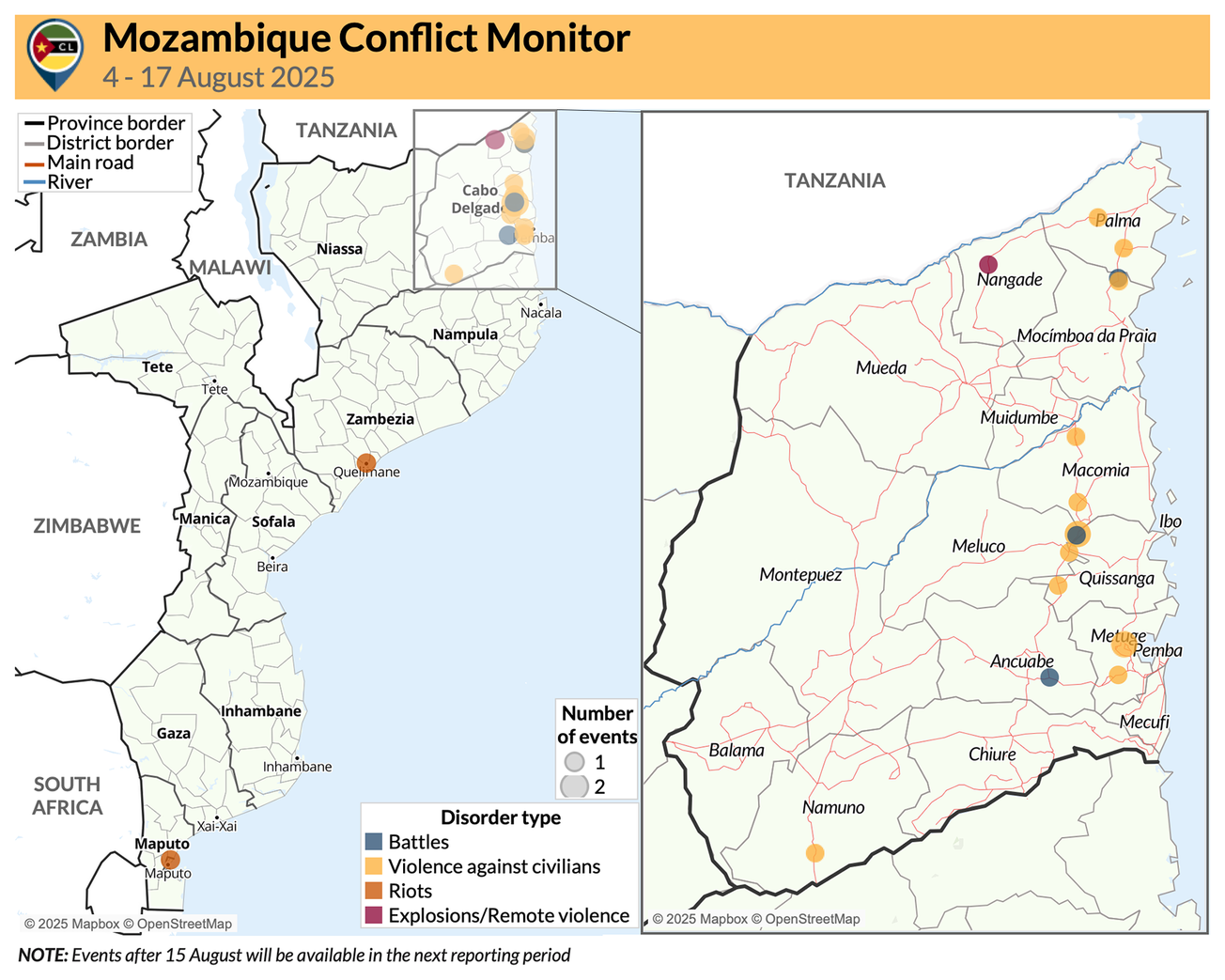
Following their recent incursion into the south of Cabo Delgado, Islamic State Mozambique (ISM) fighters were active across eight districts in the past fortnight. This wide reach was enabled by ISM operating small, mobile groups that stretched security forces. This allowed fighters in Palma district to mount three attacks, including in villages on the southern side of the liquefied natural gas plant in Afungi. As the insurgents return to Palma, the Islamic State (IS) has maintained frequent coverage of ISM in its media outlets, including the first feature video focusing on Mozambique that was released on 11 August.
Situation Summary
ISM attacks in Palma
ISM was active for at least one week in areas south and east of the Afungi LNG plant (see map below). On 5 August, two sources reported shelling by Defense Armed Forces of Mozambique (FADM) and Tanzanian forces in the Nangade district that prompted ISM fighters to disperse to Palma. The following day, ISM attacked Maputo village — just 38 kilometers south of the LNG project in Palma district on the road to Mocímboa da Praia — burning some business premises and one house. In a claim posted on social media, IS said that it targeted the house of a Local Force commander.

Following the attack on Maputo, ISM seems to have remained in the area. Following unconfirmed sightings around Maputo over some days, Defense and Security Forces, thought to be Marine Police, landed in Maganja on 11 August, south of the LNG plant, and moved inland. The operation did not deter ISM. On 14 August, the group attacked Zambia village, north of Maputo. No details of the attack have emerged yet.
ISM is also active in the west of Palma town. ISM fighters were first sighted in the area on 10 August, and are likely still there. On 16 August, two off-duty FADM soldiers and their motorcycle taxi driver were killed on the Palma-Pundanhar road. IS released photos of the deceased and one of the victim’s identity card. According to a local source, they were abducted by a small group of ISM fighters along with at least two other civilians, and killed them when the militants discovered they were soldiers. The remaining civilians were held for ransom.
ISM’s heightened activity in Palma takes advantage of the strain the group has put on FADM by moving south, and of a seeming reluctance of Rwandan forces to respond, despite having a large camp next to the LNG plant, and another in Pundanhar.
ISM fighters move north following their southern incursion
ISM moved back to Macomia district over the past fortnight after their operations in Chiúre and Ancuabe districts. Their fighters moved back the way they had come, via Meluco and Quissanga districts. At least 10 fighters arrived by sea near Pangane, having sailed from Mussemeco in Quissanga district on 18 August. Nevertheless, at least one small group has remained in the south, according to local sources.
State forces attempted to confront returning fighters on three occasions during their move north. On 7 August, FADM troops were sent to Nangumi village, which is five kilometers north of Silva Macua, to respond to an ISM attack on the town. When they arrived, FADM clashed with ISM. Two civilians were killed in crossfire, while one Local Force member was taken by ISM and later killed.
Some ISM fighters made their way slowly north through Mecufi and Metuge districts. In Mecufi, on 10 August, ISM killed a civilian near Nancaramo village on the N1, according to a claim made by IS, which mistakenly placed the village in Ancuabe district. The following day, ISM, likely the same group of militants, attacked Nacuta village in Metuge, just 15 km north of Nancaramo. According to a source, some premises were set on fire, with those of prominent individuals being targeted. Some villagers, including children, were abducted to carry looted goods and for ransom. Four days later, the group killed one civilian near Nampipi village, also in Metuge, suggesting they were not under significant pressure to move north.
N380 roadblocks continue
By the time of the Mecufi and Metuge attacks, other ISM fighters were already in Meluco district. On 6 and 7 August, ISM established roadblocks on the N380, between 19 de Outobro and Nangoro villages, approximately 30 km south of Macomia town. Over the two days, numerous vehicles were stopped. Christian drivers and passengers were taken and forced to pay ransoms ranging from 10,000 to 30,000 meticais (about 150 to 460 US dollars). On the second day, FADM arrived and clashed with the group, according to a source in touch with an affected driver. There were further, but as yet unconfirmed, sightings of ISM fighters in subsequent days in villages in the area. According to one source, the group involved in the roadblocks later moved through Cagembe in Quissanga district, seemingly returning to Macomia district.
North of Macomia town, near Chai, ISM mounted another roadblock on 14 August, despite the reintroduction of military escorts north of Macomia in July. The Chai detachment of the Local Force ambushed the ISM group as they left the roadblock. According to a local source, one Local Force member was injured in the clash, and ISM suffered undetermined casualties. Further north again, and close to the N380, ISM fighters, likely those active around Chai, killed a fisherman at a lagoon near Primeiro de Maio on 15 August.
The roadblocks prompted military escorts for traffic on the N380 between Pemba and Macomia, mirroring the other escorts along the same road between Macomia and Awasse. However, even the escorted convoys are seemingly under attack. Footage on social media claims to show an escorted convoy under attack on 17 August in Macomia district, though the exact location was not given.
Disorder in Montepuez and Namuno
Demonstrations in Montepuez town and Namuno district indicated the delicate state of local politics in the south of Cabo Delgado. In Montepuez on 13 August, police fired warning shots over informal miners who were demonstrating against their removal from the site of a new gold find near the town. In Machoca town in Namuno, trouble broke out on 15 August. According to one account, the house of the director of the medical center was attacked. Another account connected the trouble to the detention of a supporter of Venâncio Mondlane and that a subsequent protest occurred at the residence of the area police commander.
The incidents raise serious questions about governance in Cabo Delgado. The Montepuez incident indicates that there are no systems in place for managing informal mining practices, such as those that exist in neighboring Tanzania. Though details of the Machoca event are as yet unclear, it demonstrates a significant lack of faith in local government.
Focus: Mozambique video highlights IS propaganda campaign
The ISM video feature released on 11 August called “Light of Jihad” was the culmination of a month-long propaganda campaign. ISM’s operations had featured significantly in IS social media channels and its weekly newsletter, al-Naba, since mid-July.
The 18-minute film places the insurgency in the context of the oppressive rule of the colonial period, and what they describe as the continued marginalization of Muslims since independence. However, the piece presents no specific contemporary political analysis and makes no political demands. The management of natural resources, such as gemstones or natural gas, for example, is not mentioned. As is standard in IS communications, the conflict is framed as a struggle for the rights of Muslims in Mozambique, and presented within IS’s narrow theological view, while the film’s depiction of the group’s battlefield activity serves to demonstrate their strength. The film shows previously unreleased footage from attacks this year on FADM positions at Primeiro de Maio and Quiterajo, as well as statements seemingly filmed in Quiterajo and threatening further attacks. Though the themes are framed as universal, the presentation is localized through the use of Kiswahili for the most part, and a closing statement in the Emakhwa language.
However, the film is just one highlight of IS’s sophisticated social media presence. The group’s ability to distribute material through existing channels that serve Mozambican audiences demonstrates a nuanced understanding of social media that allows it to get past platform controls. For some time, IS supporters have forwarded incident claims and photo reports published by IS on its closed channels to Mozambican discussion groups and social media channels. This is an approach that has long been used by IS. In the past, IS propaganda was regularly seeded in large East African Facebook groups, connecting people to IS Telegram accounts, and directly distributing graphic material. This practice is now mostly restricted to niche platforms such as Telegram, now that Facebook and other platforms have implemented controls.
However, even Telegram is more vigilant now about its use by IS and similar groups, as individual accounts and private channels that distribute such content are regularly shut down. Counterintuitively, IS now uses public groups and channels on the platform, as well as private ones. In April this year, IS took over a mainstream Muslim Telegram public channel that had been operating since 2021 and has since been using it to issue incident claims. Messages from this channel, which has over 13,000 followers, are now being forwarded to Mozambican public channels. Another public Telegram channel established in July this year posts material that is not explicitly branded as IS, but presents granular information about IS ambitions in Mozambique, East Africa, and elsewhere. IS, or IS supporters, forward posts in Arabic from this group into Mozambican channels. In these ways, IS successfully maintains a presence on social media and reaches small though influential audiences in Mozambique.
Roundup
TotalEnergies postpones meeting with the Palma business community
A planned meeting between TotalEnergies in-country managers and representatives of the business community in the town of Palma, located next to the gas projects on the Afungi peninsula, was postponed from 12 August to 21 August. The meeting, to be held at the Palma Residences hotel, will address the question of access to the projects for local businesses in light of a recent decision from the French energy giant to lock down the site and not bring in supplies by road. A local source told MCM the reasons for the cancellation were unknown, though the cancellation came amid military operations close to the plant.
EU military mission has been a “game changer,” mission head says
The head of the European Union Military Assistance Mission in Mozambique (EUMAM Moz), Portuguese Brigadier-General Luís Barroso, said in an interview with Zitamar News that the EU’s military assistance had been a “game-changer” in Cabo Delgado. However, he also admitted that it would take “years” for the conflict to end. The mission provides ongoing support to 11 marine and commando units of FADM previously trained by EU trainers. Later this month, a mission from the EU’s External Action Service will conduct an on-site assessment of the needs of the Mozambican armed forces and the possibility of further assistance. A further team from the service will then assess whether the mission should have its mandate changed or extended, or whether it should be ended.
Insurgents accused of using child shields in Cabo Delgado
The governor of Cabo Delgado, Valige Tauabo, claimed that insurgent groups are using abducted children as human shields during attacks on villages in the province. Speaking at the Mbau administrative post in the Mocímboa da Praia district, Tauabo asserted that the insurgents use this tactic to prevent the Mozambican Defence and Security Forces (FDS) and their Rwandan allies from effectively countering their attacks. He emphasised that the insurgents abduct children, mainly aged 12 to 13, during raids and deploy them at the forefront of their operations. However, there is no evidence to indicate this is happening. Children are kidnapped and trained to fight, and have been seen in some images posted by IS. However, battlefield videos do not indicate the use of “human shields” in attacks on state forces in what are usually chaotic and fast-moving events.
The Justice Ministry approves Venâncio Mondlane's ANAMOLA party
The Mozambican Ministry of Justice, Constitutional and Religious Affairs has officially recognized the formation of the National Alliance for a Free and Autonomous Mozambique (ANAMOLA) party, which is led by the former presidential candidate Venâncio Mondlane. Mondlane initially proposed the acronym ANAMALALA, but this was rejected because it is an Emakhwa term, meaning “enough,” or “it’s over.” As that term is specific to an ethnic group, this is considered contrary to the Mozambican Constitution and the Political Parties Act. It also did not correspond to the full name of the party. Following this adjustment, the party was approved on 7 August.

)