
By the Numbers
Data highlights in Cabo Delgado province (29 September - 12 October 2025)
At least 8 political violence events (2,222 in total since 1 October 2017)
At least 6 total reported fatalities from political violence (6,272 since 1 October 2017)
At least 5 reported civilian fatalities (2,641 since 1 October 2017)
At least 9 political violence events involving ISM across Mozambique (2,050 since 1 October 2017)
Overview
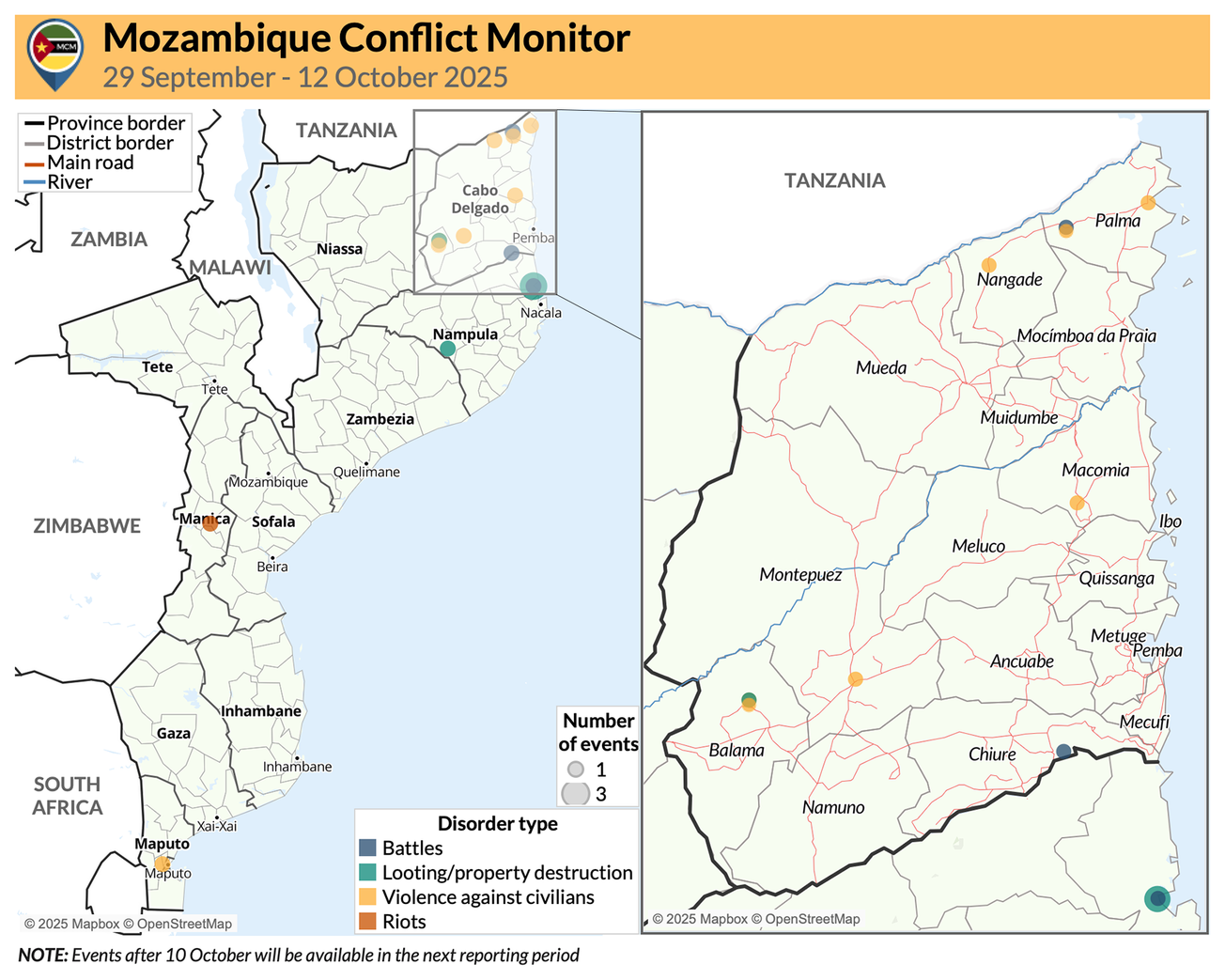
Islamic State Mozambique (ISM) undertook operations in Cabo Delgado and Nampula provinces. In Nampula, its actions displaced thousands, while it remained active in Chiúre district in southern Cabo Delgado. In the north, on 9 October, it undertook its first operation in Palma town since 2021, killing one civilian and kidnapping another, and carried out an attack in Nangade town. The group remains active in Balama and Montepuez district, maintaining a presence close to gold mining sites. Most notably, ISM representatives entered Mocímboa da Praia on 7 October to address residents. They met no resistance from either the community or armed forces.
Situation summary
Thousands homeless in Memba and Chiúre districts following ISM attacks
Between 29 September and 6 October, ISM killed one soldier and destroyed hundreds of homes and two churches in villages in Nampula’s Memba district, according to claims issued by the Islamic State (IS). The claims related to attacks on five villages across Memba. According to the International Organization for Migration (IOM), between 2 and 6 October alone, almost 2,200 people were displaced due to the group’s activity in Memba.
On 9 October, a group of ISM militants crossed the Lúrio river from Memba back into Cabo Delgado’s Chiúre district. At the village of Napala, they clashed with the Defense Armed Forces of Mozambique (FADM). IS claimed that FADM fled, and that ISM then destroyed “hundreds” of houses and a church.
Militants crossing from Nampula likely met with counterparts who were already in Chiúre district. According to IOM, over 1,100 fled the Mazeze area of the district between 3 and 6 October in response to the group’s presence.
Killings in Palma and Nangade towns
ISM attacked Palma and Nangade towns on the night of 9 October. Both operations involved ISM working in small groups to conduct brief attacks on civilians. In Palma attackers approached the town from the north and reached as far as the airport area. The attack may have been targeted. According to a local source, the militants called on a particular house and told a woman they needed to speak to her husband, who went to seek the assistance of the military. Before help could arrive, the gunmen killed the man’s nephew and kidnapped the woman, according to the source. On the same night, ISM militants entered Nangade, killed at least one civilian, abducted a boy, burned a church, and looted goods, according to sources in the town. IS claimed both attacks on its social media channels.
The next night, 10 October, ISM killed a Local Force member near Pundanhar, which lies in the west of Palma district on the Nangade road. IS also claimed this attack. Also near Pundanhar, a motorcycle taxi driver was kidnapped, likely by ISM militants, and a ransom of 50,000 meticais was demanded. It is not known if the driver was released.
Residents of both Nangade and Palma towns remain fearful. In Nangade, militants were seen moving toward Nangade town on 6 October. On 10 October, one day after the attack, they were still within one kilometer of the town. Palma, too, is uneasy. On 12 October, people panicked after hearing a rumor of a further attack and looked to leave the town. According to a source in the town, the rumor was spread by bus operator interests.
ISM remains in Balama and Montepuez districts
ISM remains active in Balama and Montepuez districts, over six weeks since a group of almost 100 arrived in Montepuez after trekking from Muidumbe and Macomia districts. At the start of the month, on 2 October, militants attacked Mpaka village, where they killed one civilian and destroyed some property. The same day, they attacked the nearby Tatango village, where they burned a church and other property and spent the night. According to the MozaNorte news site, military forces arrived in Mpaka on 2 October but did not move to Tatango, despite being told of the insurgents’ presence there. The two villages lie approximately 20 km north of Balama town.
According to a source with strong contacts in the area, the original group of up to 100 is now organized in four groups. The largest is thought to be based in the north of Balama district, near the Messalo river, while three small groups operate further south. Though isolated, the area is rich in minerals, which has likely prompted their sustained presence across the two districts. On 7 October, a group of ISM militants appeared at the Ntola gold mining site, where they called a meeting of miners. According to a source in the mining sector, they stated that they had come to stay but required daily contributions, presumably cash, and threatened to burn property if their demands were not met. They also said they wanted access to gold, according to the source.
Focus: The insurgency comes full circle in a Mocímboa da Praia mosque
On 7 October, after nightfall, a group of up to eight ISM armed militants entered the southern side of Mocímboa da Praia town and made their way to a mosque in the Nabubussi neighborhood in the Milamba area. After making an address, they made their way out of the town again, meeting no resistance. They had just made their most high-profile and public statement since the insurgency began eight years ago.
The address in the Nabubussi mosque was conceived as a media event. Three ISM fighters, dressed in FADM military gear, stood before a crowd of women, men, and children that they had gathered into the mosque. It was after 7:30 p.m., and evening prayers were over. The speaker held a wireless microphone as one of his colleagues recorded him on a mobile phone for a clip to be released four days later on IS media channels. Many in the crowd had their phones raised, openly recording. Others were outside, crowded around the windows, watching. Clips of the address were in circulation locally that evening.
The northern Mozambique insurgency was seeded in mosques and religious schools in Mocímboa da Praia. In choosing a mosque in the town for their most public statement yet, ISM raised significant questions about state authority in northern Mozambique, and indicated that its organizing ideological framework remains consistent. By entering the town in this way, the group also demonstrated that it is the only IS affiliate in East Africa with real political power in its sights, however distant.
ISM’s ability to enter the town, call residents for a public meeting, and leave peacefully indicates the weakness of state authority in the town. It is not clear if the Mozambican authorities and Rwandan forces were wholly unaware of the incursion or reluctant to engage in a residential area. It is clear that those residents of all ages gathered for the meeting showed no fear of the armed men speaking to them. Concerns about the level of local support for the insurgency expressed in recent weeks by Rwandan and Mozambican security officials are clearly not unfounded.
From clips in circulation, the speaker’s address was simple. He first presented ISM as a legitimate authority in opposition to Frelimo. In this, he echoed one of the group’s earliest messages from 2020, from Quissanga. He then said his Muslim audience had a duty to support the group in jihad. He went on to warn them not to collaborate with the authorities, and to attend none of their meetings. Finally, in stating that only the “army of Islam” can bring peace, he rhetorically asked if the Rwandan army was there.
The event took place on the same day that a government team arrived in Pemba for a series of consultations for the Inclusive National Dialogue (DNI), a presidential initiative to encourage dialogue across political divides. Though Mocímboa da Praia was not on the group’s itinerary, ISM’s actions kick-started difficult conversations at a public meeting held on 10 October. Attended by hundreds and overseen by Cabo Delgado Governor Valige Tauabo, one speaker wondered if the insurgency was actually a Makonde plot against coastal peoples. At the meeting, Governor Tauabo invited insurgents to take part in the DNI. Given their relative freedom of movement in Mocímboa da Praia, this is not an outlandish idea, particularly following President Daniel Chapo’s recent suggestion of dialogue.
Just the possibility of dialogue with the state means that ISM has made more political progress than more famous IS affiliates in the Democratic Republic of Congo or Somalia. Both are resilient, but isolated, groups, and both physically and politically distant from real power. ISM, on the other hand, has returned to the town of its birth, been accepted by some, and been invited to talk.
Roundup
Inclusive National Dialogue team arrives in Cabo Delgado
The DNI team that arrived in Cabo Delgado on 7 October is scheduled to remain until 17 October. The team planned to meet with community representatives in Pemba, Mecufi, Metuge, Chiúre, Ancuabe, Montepuez and Balama districts. DNI is an initiative President Chapo launched in April to build “lasting consensus as the basis for stability.” Envisaged as taking place “from Rovuma to Maputo,” the consultation team won’t make it any further north than Metuge. Any dialogue with insurgents, as suggested by Governor Tauabo, will be much more discreet than that envisaged in the formal process.
Chapo confirms Rwandan forces to stay until 2029, guarding gas project construction
President Chapo announced on 2 October that Rwandan forces will remain in Mozambique until two onshore liquefied natural gas (LNG) projects in Palma district are built, currently expected in 2029. He was speaking at an event to mark Italian company ENI’s final investment decision for a second floating liquefied natural gas (LNG) facility off the coast of Cabo Delgado. At the ceremony in Maputo, Chapo said the status of forces agreement, inked with Rwanda in August, “confirms the extended presence of Rwandan forces in Cabo Delgado, at least during the construction period of the Mozambique and Rovuma LNG projects,” led by TotalEnergies and ExxonMobil, respectively. The agreement with Rwanda means that “the conditions have now been met for the lifting of force majeure on the Mozambique LNG project,” Chapo said.
The Mozambique LNG project in Palma district has been suspended since TotalEnergies withdrew workers and declared force majeure in the wake of the insurgent attack on Palma in 2021. In practice, work has continued, with 2,000 workers now on site. But the firm is understood to be waiting for the government to agree on an updated plan of development for the project that takes into account 4.5 billion USD in expenses it says it has incurred due to the 4 1/2-year stoppage, before lifting force majeure.
)