
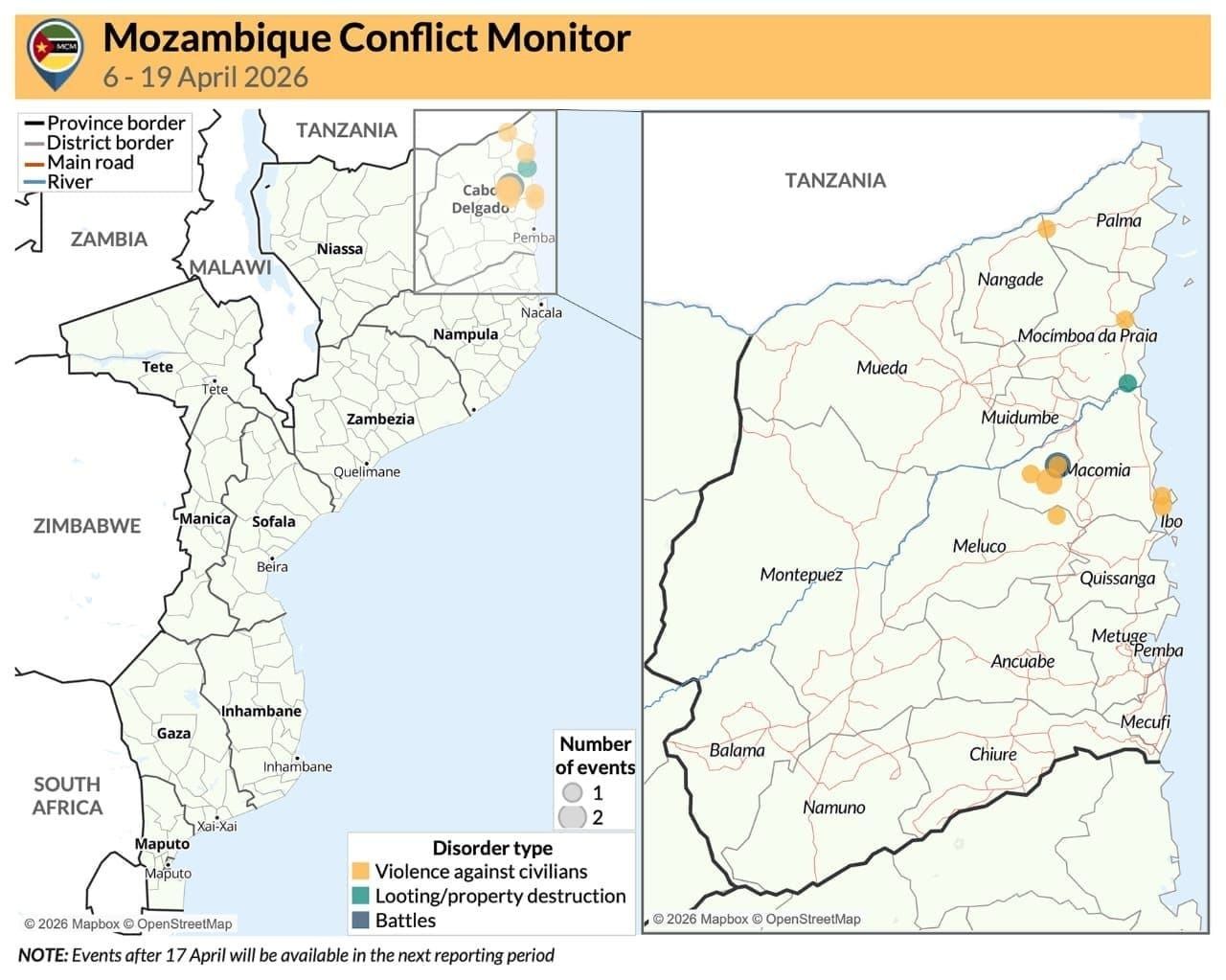
By the Numbers
Data highlights in Cabo Delgado province (6 - 19 April 2026)
At least 11 political violence events (2,356 in total since 1 October 2017)
At least 9 total reported fatalities from political violence (6,527 since 1 October 2017)
At least 4 reported civilian fatalities (2,739 since 1 October 2017)
At least 10 political violence events involving ISM across Mozambique (2,184 since 1 October 2017)
Situation summary
Tanzanian fighters captured in Nangade
Insurgents have been active in Nangade district for the first time since December. On 14 April, Mozambican security forces captured 10 Tanzanians, suspected insurgents, close to Mandimba in the north of Nangade region. The following day, another group of ISM militants attacked Machava, a farming settlement less than 20 kilometers further south, with no reported fatalities. On 20 April, they entered Nkonga, a village in central Nangade, looking for food.
According to a local source, these attacks were undertaken by ISM recruits who had crossed from Tanzania, and the attacks were attempts to procure food for the journey south toward Macomia. According to the source, the group captured at Mandimba had regrouped there after failing to find a route south.
Tanzanian boat intercepted by navy, then ISM
The Tanzania connection was also evident on the coast, where a Tanzanian fishing boat had the misfortune of being targeted first by a Mozambican navy patrol, and days later by ISM. On 12 April, a navy patrol stopped the boat as it was moving north between Matemo and Rolas islands, in Ibo district. According to two sources, the boat, which was carrying shellfish, was taken to Rolas Island where the Tanzanian captain was forced to pay a bribe of up to 20,000 meticais to continue the journey.
Two days later the boat was stopped by ISM at the mouth of the Messalo river. The captain had taken that route hoping to avoid navy patrols operating from Quilanhune Island. ISM held the boat overnight until a ransom was paid. The insurgents also seized the cargo before allowing the boat to continue its voyage back to Tanzania.
On land, ISM militants were active in Mocímboa da Praia. On 8 April, near Nachiji village south of Mocímboa da Praia town, a group of insurgents stopped a trader on a motorbike and stole her goods and 7,000 meticais in cash. They continued to Nabaje village, just 14 km south of Mocímboa da Praia on the coast. There they took foodstuffs, then left in a stolen boat.
ISM kills six in village attacks west of Macomia
Between 10 and 14 April, a group of ISM fighters attacked four villages west of Macomia town, killing at least six civilians and abducting two. The first attack was on Nkoe village, over 22 km northwest of Macomia town. The attacks illustrate how the N380 is emerging as a demarcation line between communities: ISM takes a more violent approach to the west of the road, where the Frelimo-associated Local Force is strong. To the east, where they exert greater control, their engagement is much less violent.
The group then moved south, hitting Nguida and Chicomo, directly west of Macomia town, before attacking Iba village in neighboring Meluco district. According to one source, the group, made up of 100 well-armed men, made its way west toward the mines at Minhanha and Ravia.
Focus: Transit corridors from Tanzania remain active
Events in Nangade and off the Ibo and Macomia coasts last week are a reminder of how open the border with Tanzania remains, over eight years since the insurgency began. ISM relies on connections with Tanzania to receive new recruits from Tanzania and elsewhere in the region, to receive supplies, and to maintain relations with support networks north of the Ruvuma river.
Mandimba, where 10 Tanzanians were discovered on 14 April, lies just 8 km from Tanzania’s Mtwara region. It is a critical part of the Tanzania corridor that extends south to Mocímboa da Praia and Muidumbe districts, and finally to ISM strongholds in Macomia district. That the 10 were unable to find their way south is evidence that, though the Nangade route is still active, the insurgents do not have a strong foothold or support network in the district. With a primarily Makonde population and with relatively strong Frelimo structures, it was one of the first districts to establish the communal defense militias that would later become the Local Force. Consequently, ISM has never established itself in the district, although a mosque in Nangade town was identified as a site of radicalization in the insurgency’s formative years, prior to 2017.
ISM’s ability to hold a Tanzanian vessel for ransom and seize its cargo on 14 April indicates that Mozambique does not have control of its littoral waters. That the navy itself held the same boat for ransom two days before demonstrates that the authorities are not focused on addressing the insurgent threat. Consequently, the littoral waters are likely an important logistical corridor for the insurgents. The navy’s continued patrols along the Macomia coast appear to be targeting local marine traffic — sometimes fatally — while larger vessels continue to ply between the two countries. The continued traffic of commercial vessels, despite the risks, presents clear opportunities for the insurgents to move personnel and arms to Mozambique, and for others, potentially including leaders, to move to Tanzania when needed.
Policing marine traffic will remain Mozambique’s responsibility. Tanzania has traditionally maintained a policy of containment toward armed groups in neighboring countries, tolerant of their presence within its borders if their actions are targeted elsewhere. For instance, Jamal Mukulu, founder of the Allied Democratic Forces, which became Islamic State Central Africa Province, lived in Dar es Salaam for some years before his arrest in 2015. This approach is unlikely to change. Though the United States is exerting pressure on Tanzania to expedite an ExxonMobil-backed liquefied natural gas project in southern Tanzania, contractual rather than security issues have impeded the project’s progress over the years. Therefore, Tanzania will be under little external pressure to clamp down on these networks.
Roundup
Frelimo divided as Mozambique’s unpaid bill strains Rwanda ties
Relations between Maputo and Kigali have deteriorated due to Mozambique’s failure to pay the RDF deployed in Cabo Delgado, according to Africa Intelligence. The debt has exceeded 22 million US dollars, equivalent to roughly a year of missed payments under an agreement that Mozambique provides monthly transfers of about $2 million. The situation reflects the state’s financial strain, marked by high public debt and limited revenues, which constrains its ability to meet external obligations of this kind.
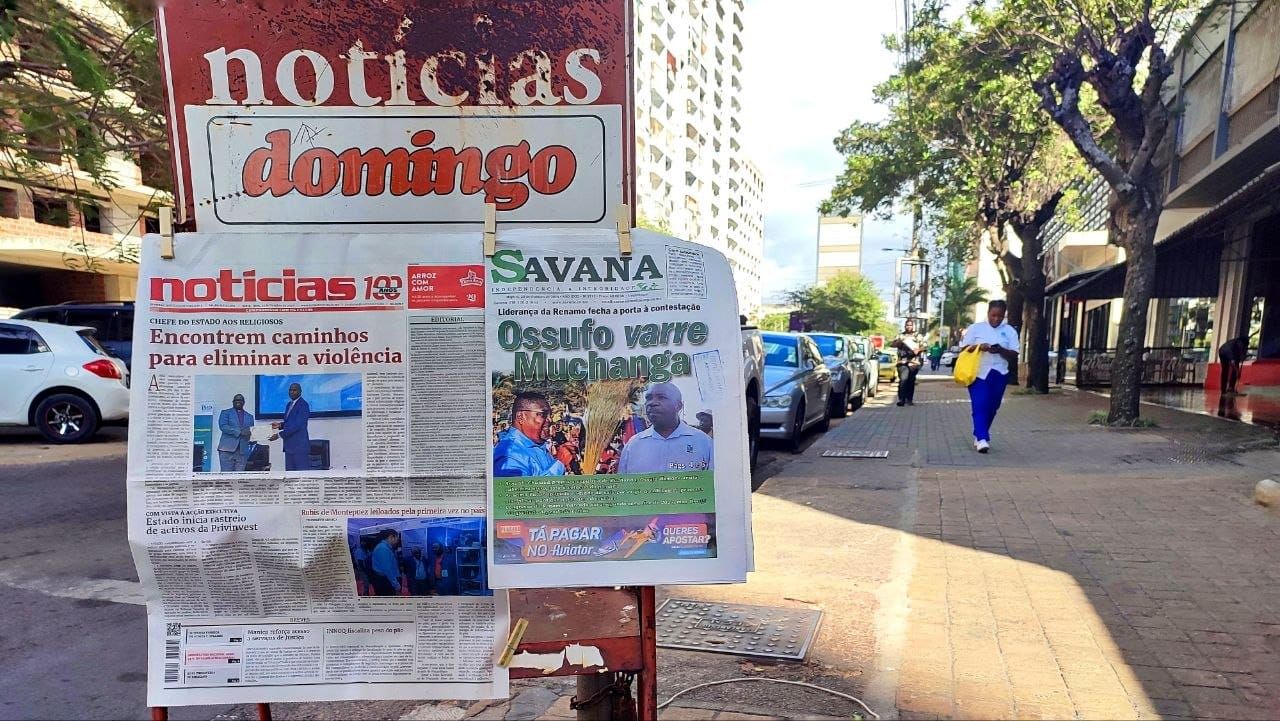
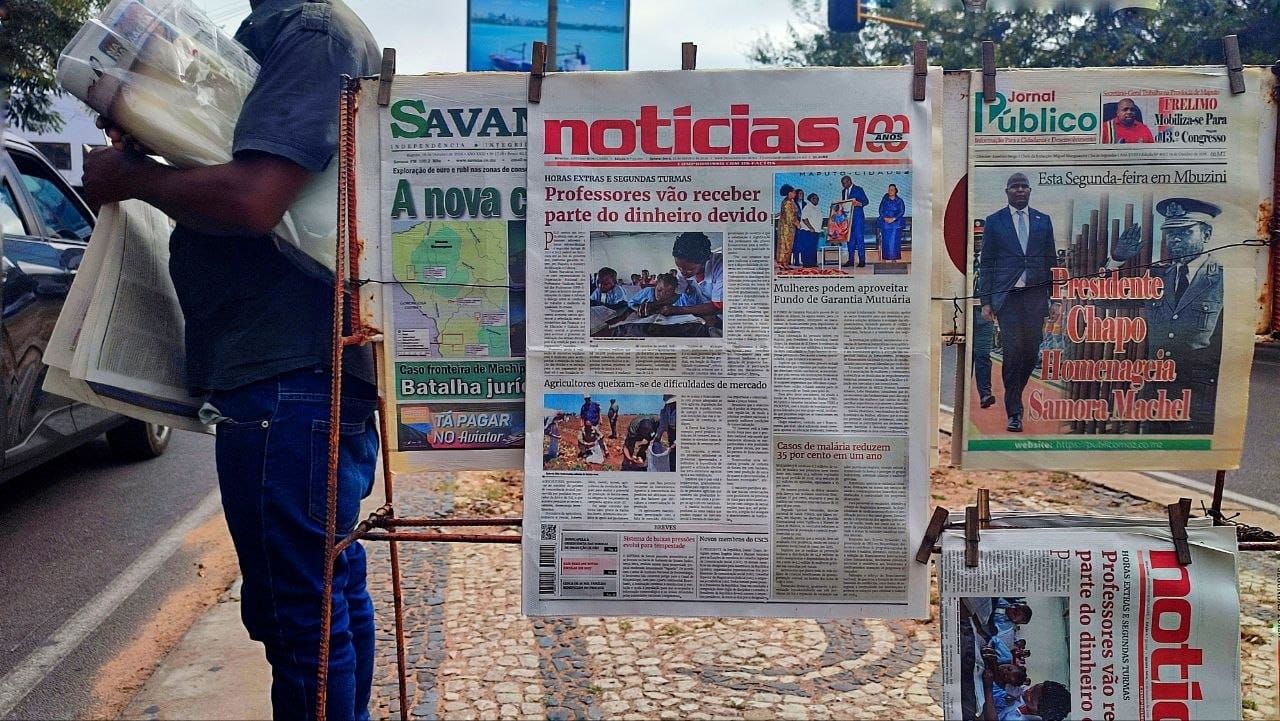
The payment delays also expose divisions within Frelimo over the continued presence of Rwandan troops. According to the Savana newspaper, one faction argues for their withdrawal, while another sees the RDF as essential to containing the insurgency and securing areas linked to gas projects. Companies such as TotalEnergies and ExxonMobil have pushed for their continued deployment through the construction phase. Still, the failure to pay the troops raises doubts about the arrangement's sustainability in the medium term.
Soldiers arrested over attempted sale of 2,000 weapons
Mozambican authorities have detained four individuals in Beira over the possession of more than 2,000 weapons, including members of the Defense and Security Forces and a Chinese national. Prosecutors say the soldiers intended to sell obsolete weapons to a foundry owned by the Chinese citizen, in violation of regulations requiring their destruction.
The suspects reportedly transported the weapons in a Mozambican military vehicle to the foundry, where they were to be received. The case has been referred for judicial proceedings and highlights broader weaknesses in the military’s arms disposal processes.
)