
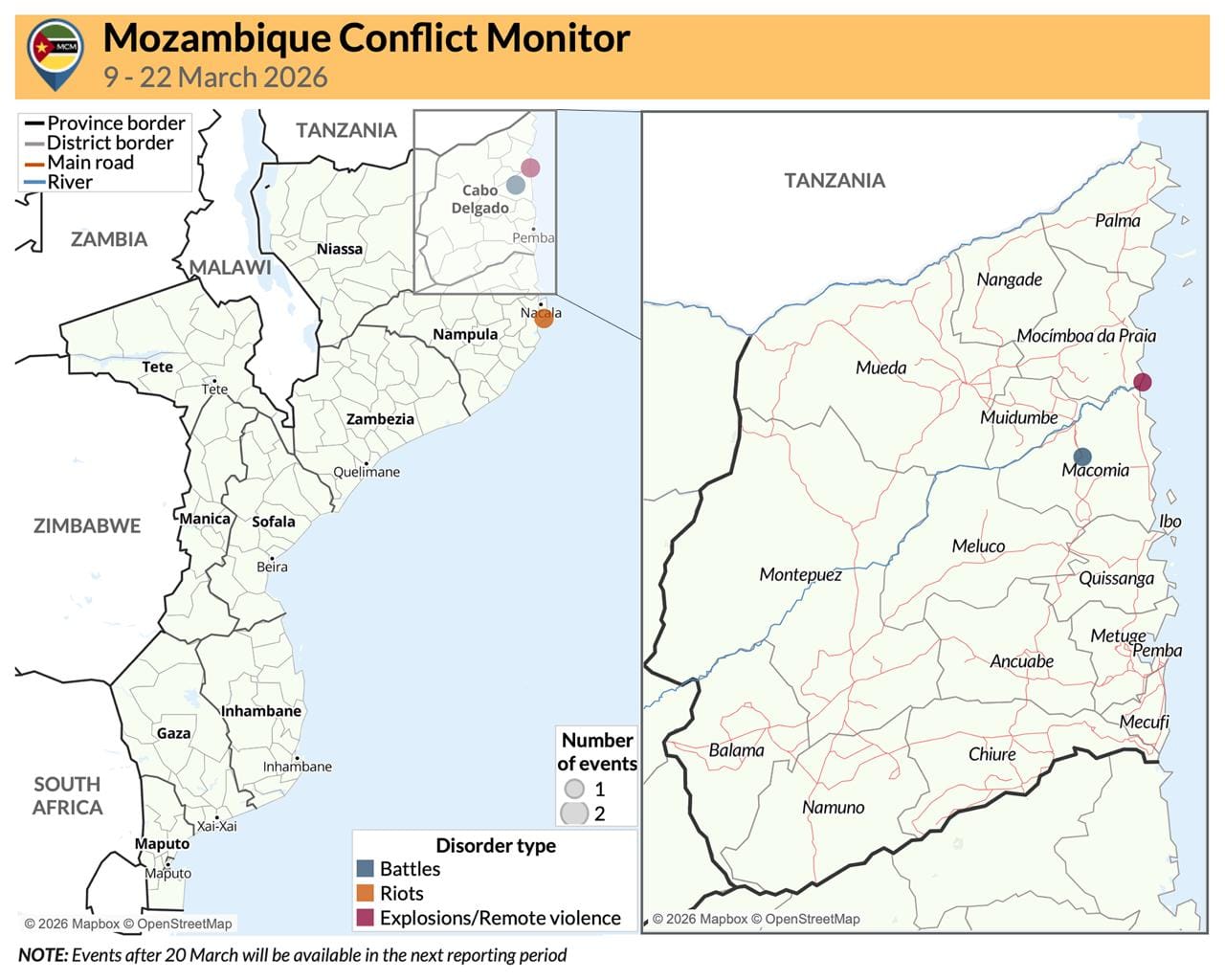
By the Numbers
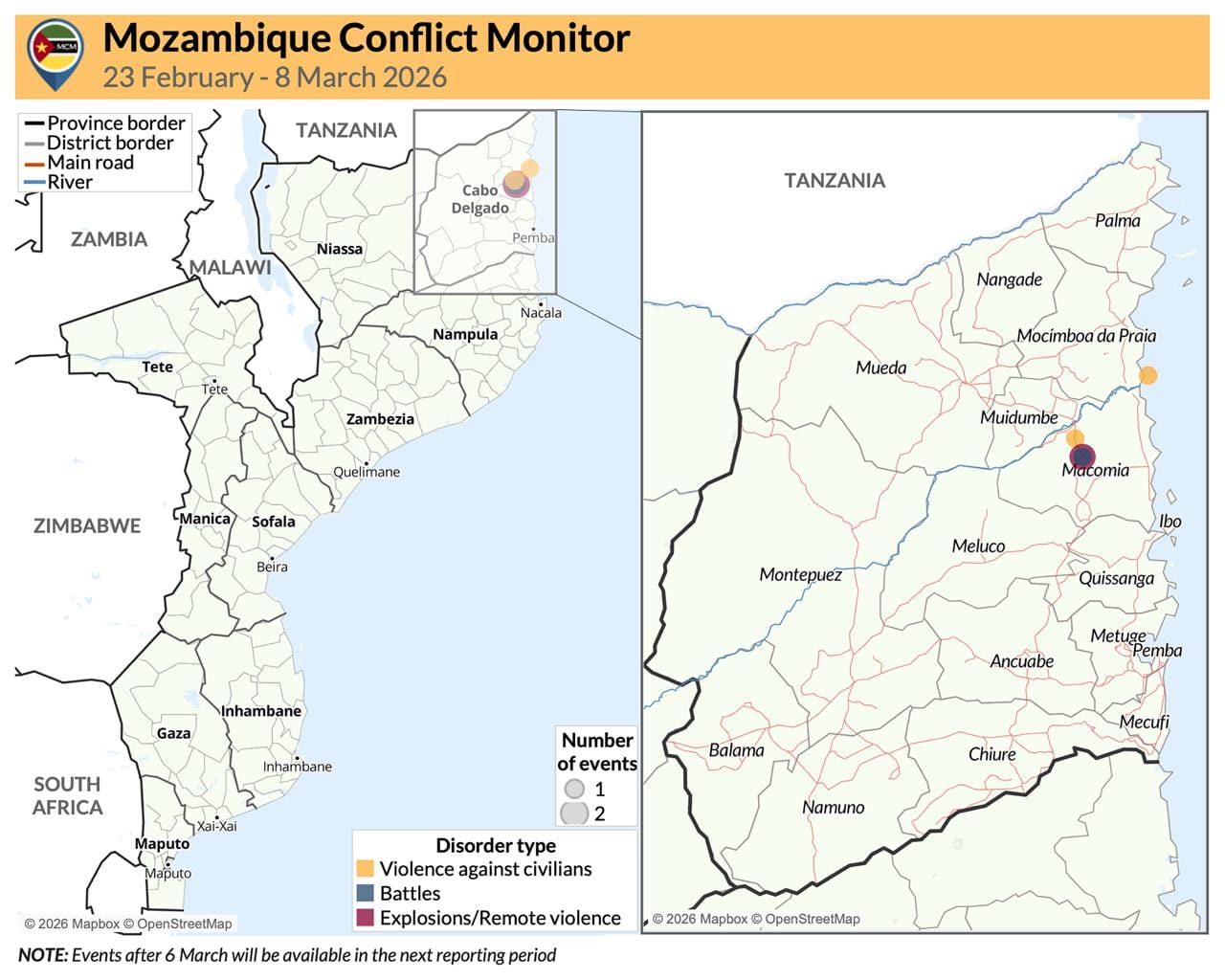
Data highlights in Cabo Delgado province (9 - 22 March 2026)
At least 2 political violence events (2,342 in total since 1 October 2017)
At least 13 total reported fatalities from political violence (6,515 since 1 October 2017)
At least 13 reported civilian fatalities (2,732 since 1 October 2017)
At least 1 political violence event involving ISM across Mozambique (2,172 since 1 October 2017)
Overview
A Defense Armed Forces of Mozambique (FADM) navy patrol fired on six fishing boats off Mocímboa da Praia on 15 March, killing at least 13 people. This continues a trend of FADM attacks on civilian boats in Cabo Delgado’s nearshore waters that has increased significantly since 2024. Elsewhere in the province, operations against Islamic State Mozambique (ISM) militants continued in Catupa forest. Further south, in Meluco district, the Rwanda Defence Force (RDF) established a new outpost on the N380, even as Rwanda’s foreign minister raised the prospect of withdrawal from Cabo Delgado.
Situation summary
FADM kills at least 13 fishers off Mocímboa da Praia
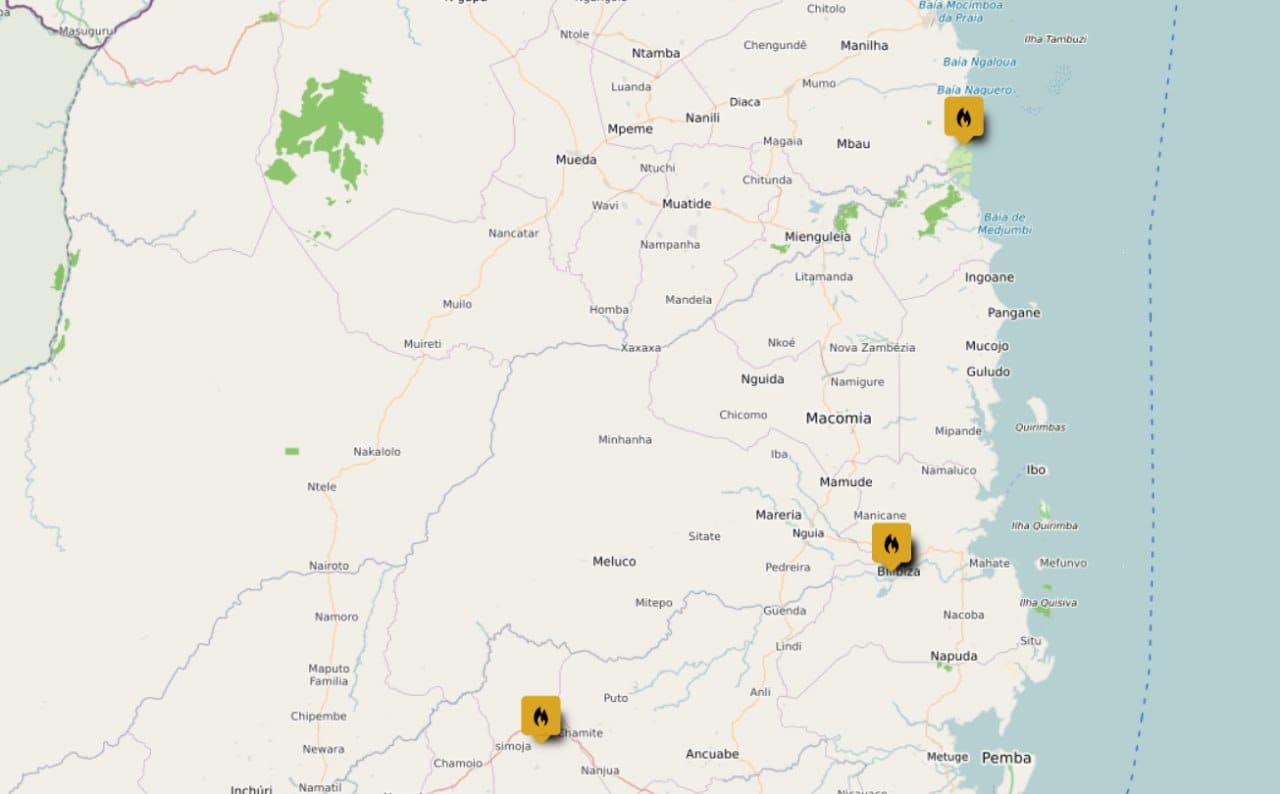
On the morning of 15 March, in waters near Calugo village in southern Mocímboa da Praia, soldiers on a FADM navy vessel opened fire on six fishing boats, killing at least 13 young men, according to Zitamar News. The men were from the Ntende area of the Nabubussi neighborhood of Mocímboa da Praia town.
The killings came in the wake of a similar incident on 6 March, when soldiers of FADM’s navy opened fire on a boat near Lucete, north of Calugo. There were no casualties. Such incidents have increased significantly since January 2024 (see the Focus section below).
FADM is aiming to assert maritime control, but the effectiveness of its aggressive approach is questionable. Six days later, according to sources in the village, a group of ISM militants celebrated Eid al-Fitr in Ulo village, further up the coast and just 12 kilometers from Mocímboa da Praia town. Clearly, coastal communities are not turning their backs to the insurgents. The continued killings at sea are unlikely to sway public sympathies toward FADM.
Clashes continue in Catupa forest
Even as some militants spent a peaceful Eid in Ulo, others were engaged in clashes in Catupa forest. According to multiple sources, on 20 March, people in Quinto Congresso heard heavy gunfire from the direction of Catupa forest. The fighting likely involved FADM, possibly with Rwanda Defence Force (RDF) support, trying to take ISM positions in the forest. ISM’s headquarters is thought to lie deep in the most wooded part of the Catupa area, though surrounded by a number of outposts that ISM refers to as “ribats.” There has been intermittent fighting in the area since ISM overran two FADM positions in Catupa forest on 31 January.
One of those outposts may be close to the Messalo river, approximately 6 km to the east of the N380 road, according to a reliable source, who reported that a large number of fighters were on site.
RDF establishes position in Meluco district
The RDF has set up an outpost at the 19 de Outubro village, popularly known as ADPP, in Meluco district, about 35 km south of Macomia town on the N380, according to a source in the area. The position is located at the junction with the R767, allowing access to Quissanga to the east, Meluco to the west, and Ancuabe to the south.
Focus: A deadly fishing embargo
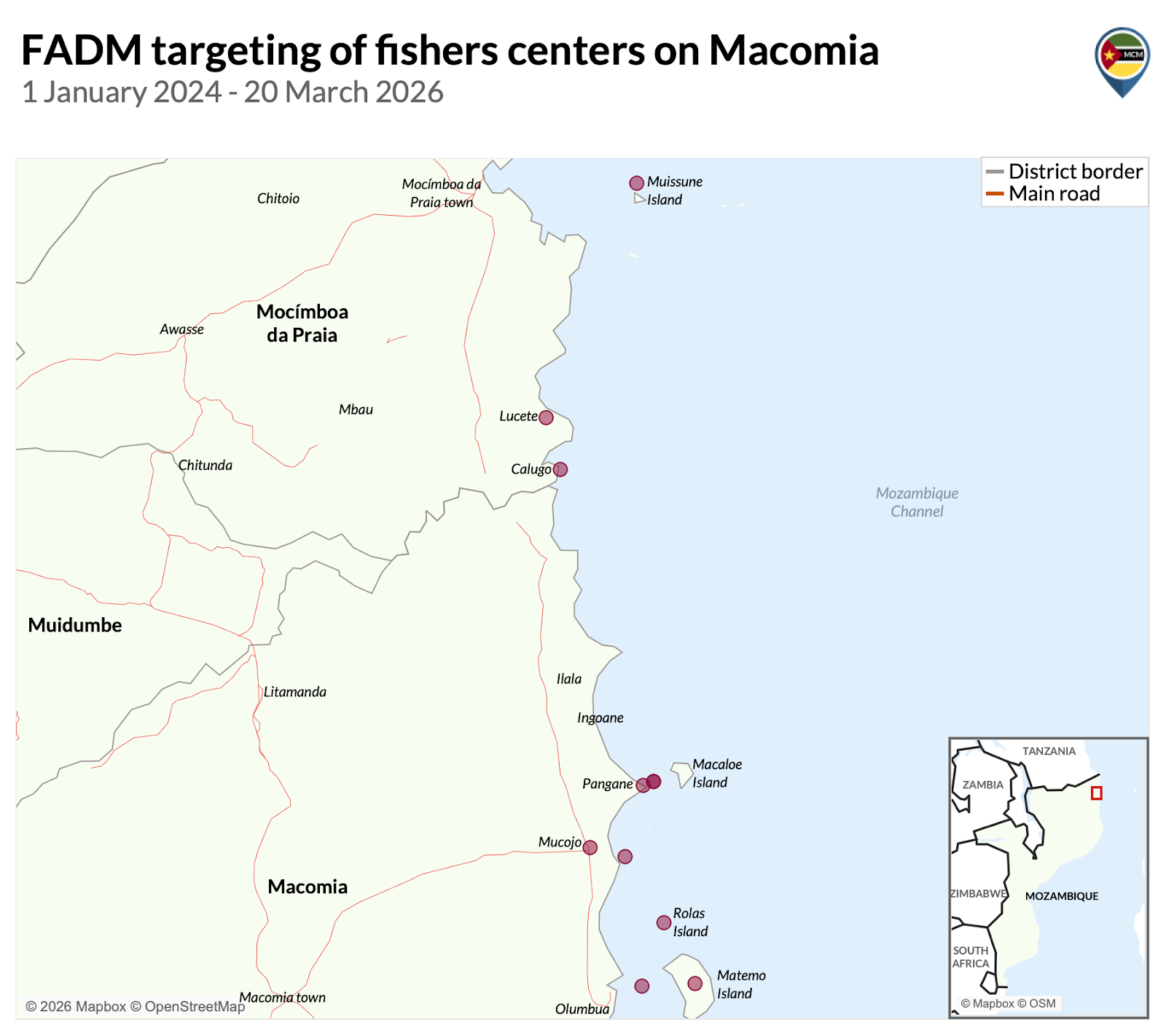
Data suggest that FADM’s terms of engagement at sea changed in early 2024, leading to a significant increase in civilian fatalities (see chart below). Since January 2024, FADM’s navy has targeted fishers at least 10 times between Muisunne island off Mocímboa da Praia town in the north to Matemo island in the south. The most deadly event was in January 2024, when FADM killed 30 fishermen close to Muissune Island (also known as Suna Island), approximately 20 km out from Mocímboa da Praia town.
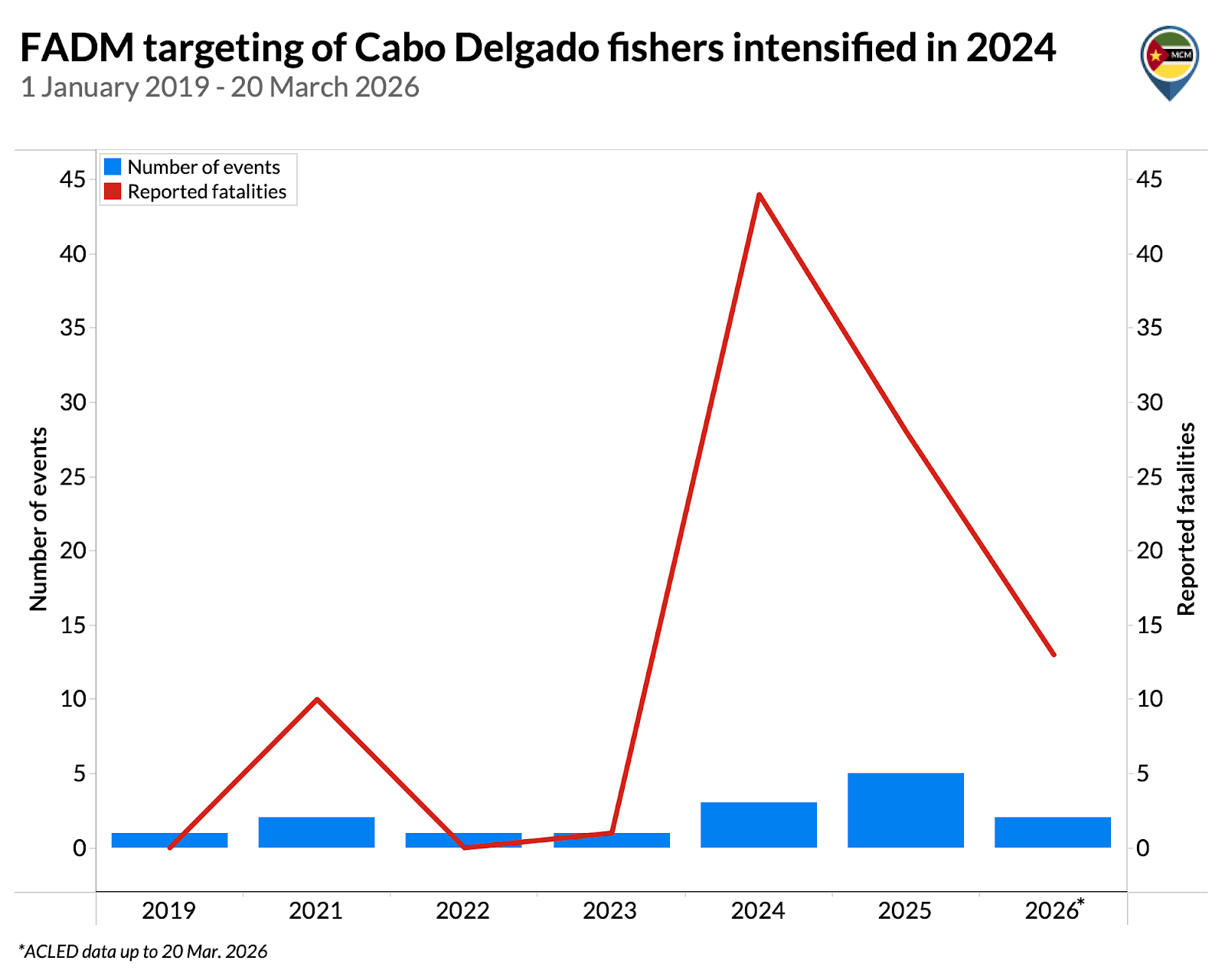
From 2019 to 2023, FADM targeted fishers five times, resulting in 13 fatalities. In the less than two and half years since, there have been 10 such events resulting in at least 85 deaths, with most concentrated in Macomia (see map below).
FADM’s restrictions on fishing stem from its concerns that ISM can move supplies and personnel in the guise of civilian boats. There is, effectively, a current ban on small boat traffic close to shore. But it is unclear how FADM defines these restrictions, and it does not clearly communicate which areas are affected. Fishers in Macomia district complained of the risks the restrictions pose in September 2025, saying they had been able to perform their work. But with economic opportunities scarce in Cabo Delgado, many young men continue to go to sea. The fishers targeted in the most recent incident were reportedly aware of ongoing restrictions, but chose to fish anyway.
FADM’s indiscriminate targeting of civilian boats likely builds resentment toward the state in coastal communities and potentially encourages support for ISM.
Roundup
Rwanda threatens to withdraw troops from Mozambique
Rwanda has warned it may withdraw its troops from Cabo Delgado if international partners fail to provide reliable funding. Officials from Kigali say Rwanda has borne most of the costs since deploying forces in 2021, receiving only limited support from the European Union. They argue the mission’s future depends on “adequate and predictable” financing and respect for Rwanda’s contribution, noting that their forces have helped secure key areas and protect major gas projects.
Despite the strong rhetoric, a withdrawal of Rwandan forces from Cabo Delgado appears unlikely. The mission remains central to security in Cabo Delgado and to the protection of major liquefied natural gas investments, making Rwanda’s continued presence strategically important. EU funding covers only limited logistical costs and is unlikely to be the main issue. Instead, the warning appears to be tied to wider geopolitical pressures, including recent US sanctions linked to Rwanda’s alleged support for M23 rebels in eastern DRC. The statement may also be intended for key beneficiaries of Rwanda’s presence, notably TotalEnergies and ExxonMobil, as well as their government backers.
UN experts warn AfDB that LNG funding risks human rights and climate harm
Four United Nations human rights experts have expressed serious concerns over the African Development Bank’s (AfDB) 150 million USD loan for the Coral North floating LNG project in northern Mozambique, warning that it could worsen human rights abuses, environmental damage, and climate risks. They say the project could exacerbate existing problems in Cabo Delgado, where past gas developments have displaced communities, disrupted livelihoods, and provided few local benefits due to inadequate consultation and limited job opportunities. The experts also caution that expanding fossil fuel infrastructure will increase greenhouse gas emissions, undermine global climate targets, and divert scarce public funds from renewable energy.
ExxonMobil expects to make a final investment decision in the second half of 2026
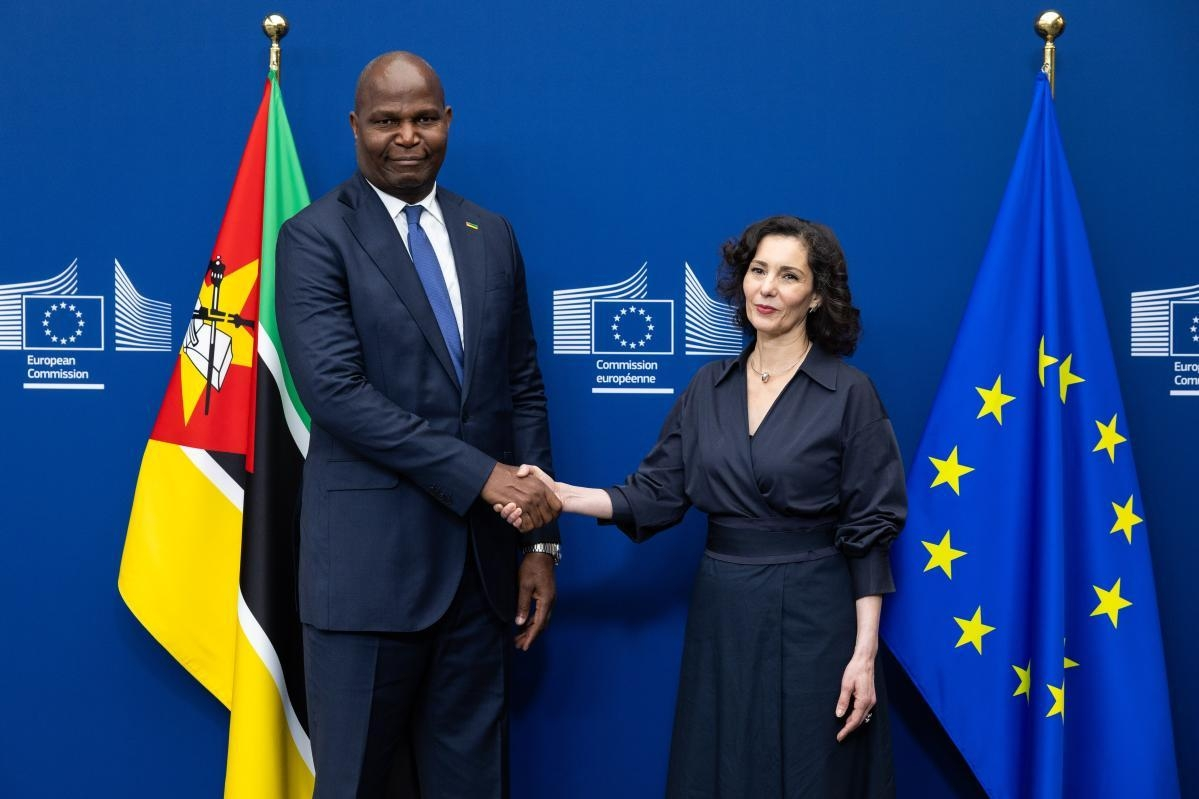
President Daniel Chapo announced that ExxonMobil plans to make a final investment decision on the Rovuma LNG project in Cabo Delgado during the second half of 2026. He announced this during his visit to Brussels, where he met with company leaders. Chapo said the government approved two resolutions to establish multi-sector teams dedicated to the TotalEnergies and ExxonMobil projects. The aim is to improve coordination and accelerate technical and operational processes.
)