By Mariana Abreu
Additional reporting by Costanza Gambarini and Luke Barratt (SourceMaterial), Gaëlle Laleix (RFI), Jörg Brase (ZDF)
Warning: This article contains explicit descriptions of rape, sexual abuse, and child abuse;
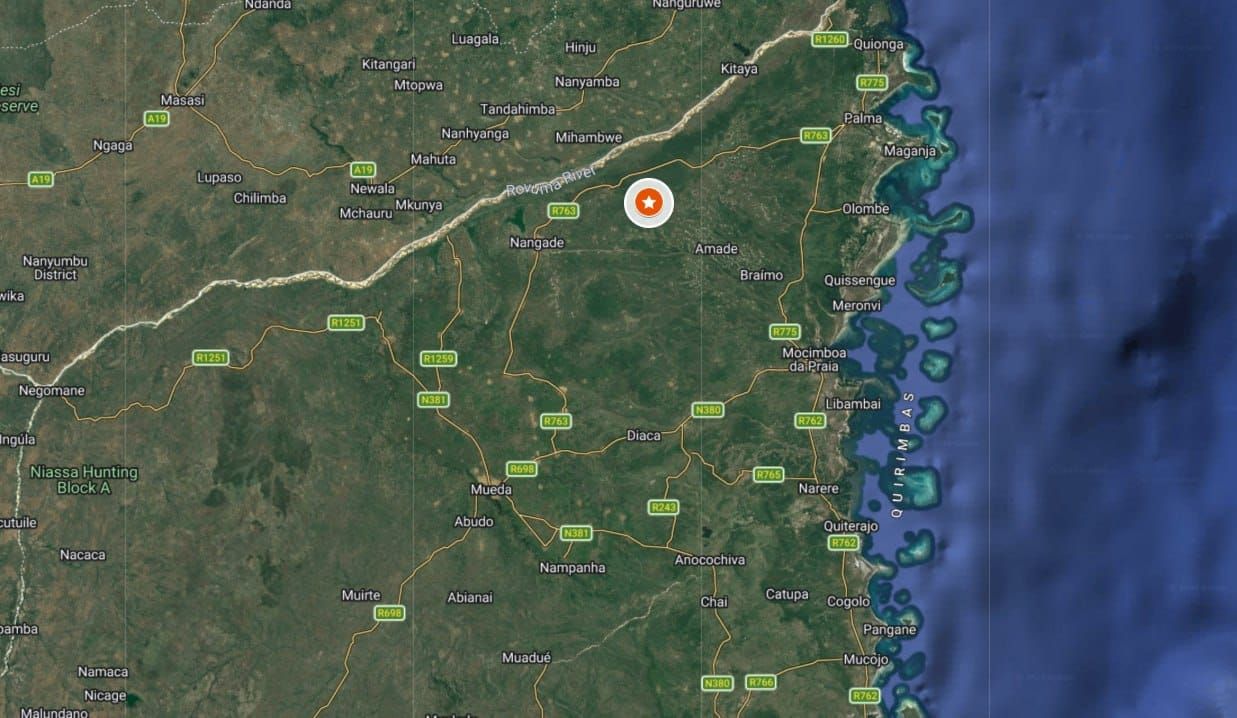
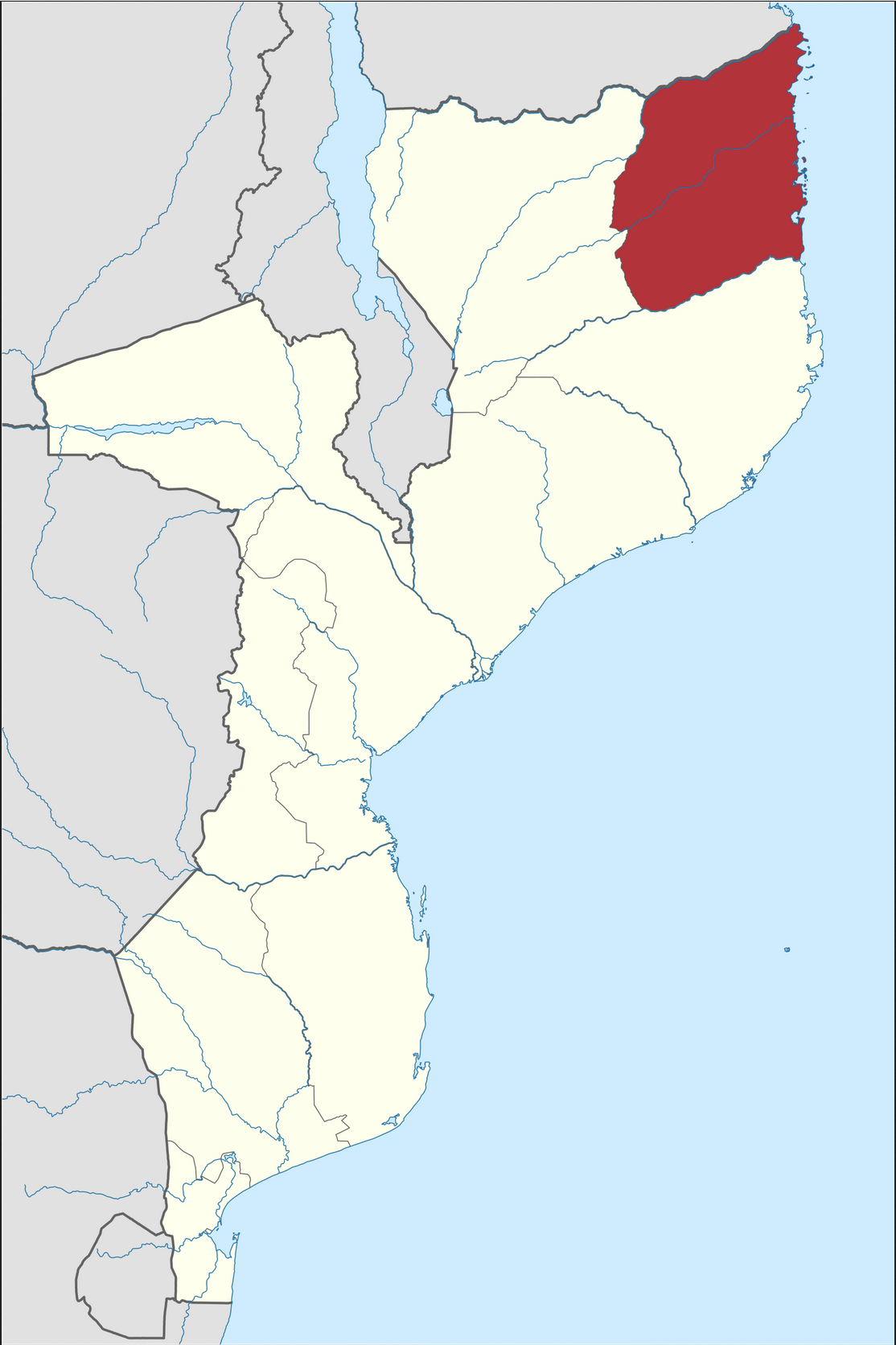
In 2019, the French energy giant TotalEnergies began operations on an extraction project in Cabo Delgado, Mozambique’s northernmost province and one of the country’s poorest regions. There, TotalEnergies established Mozambique liquefied natural gas (LNG), one of the world’s largest LNG projects, with investments totaling over 20 billion dollars. By then, residents had already endured two years of violence at the hands of an Islamic State-affiliated, local Islamist insurgency known as Al-Shabaab. The conflict has claimed over 6,000 lives and displaced over 1.3 million people.
Now, previously unpublished documents and interviews reveal women and girls have borne the heaviest burden, facing sexual violence from all sides, including by some of the Mozambican soldiers initially deployed to protect them and by some employees working for the TotalEnergies’ led Mozambique LNG project.
In 2025, Tomazina*, a 25-year-old resident of Palma, a coastal town in Cabo Delgado that neighbours the Mozambique LNG project site, travelled to the TotalEnergies compound in the Afungi Peninsula, some 20 kilometers away. Tomazina, whose name has been changed for her protection, had heard about vacancies there and wanted to submit a job application.
“There were so many people,” she told Forbidden Stories. She was hopeful when the man in charge of collecting applications pulled her from the line and suggested she give him her phone number to discuss opportunities.
“He called me that afternoon,” Tomazina recalled. Then he said, ‘I’m going to help you get that job, but in exchange I also have a request. I’d like to have sex with you.’” A week later, their relationship became sexual. Tomazina soon contacted him to ask about the job, but he “stopped responding to my messages,” she said.
Between January and April 2024, a UN agency dedicated to sexual and reproductive health, collected testimonies that describe similar accounts, including how women and girls were allegedly coerced into sex by men linked to the Mozambique LNG project, in exchange for employment.
“They tell women and girls that if they sleep with them, they will give them a job. Girls accept, and men say, ‘The job will come soon,’ but sometimes, it does not even come,” a resident told the UN agency.
These testimonies were assembled into a previously unpublished report, titled “Voices of Mozambique,” which sought to document gender-based violence (GBV) in the region. The accounts were gathered across the districts of Mueda, Nangade, Muidumbe, Palma, Mocímboa da Praia, Macomia, and Mecufi, through interviews with more than 100 people, including survivors from displaced, host, and returnee communities, as well as local figures and GBV specialists. The latter included national authorities, religious leaders, academics, and national and international protection and humanitarian actors.
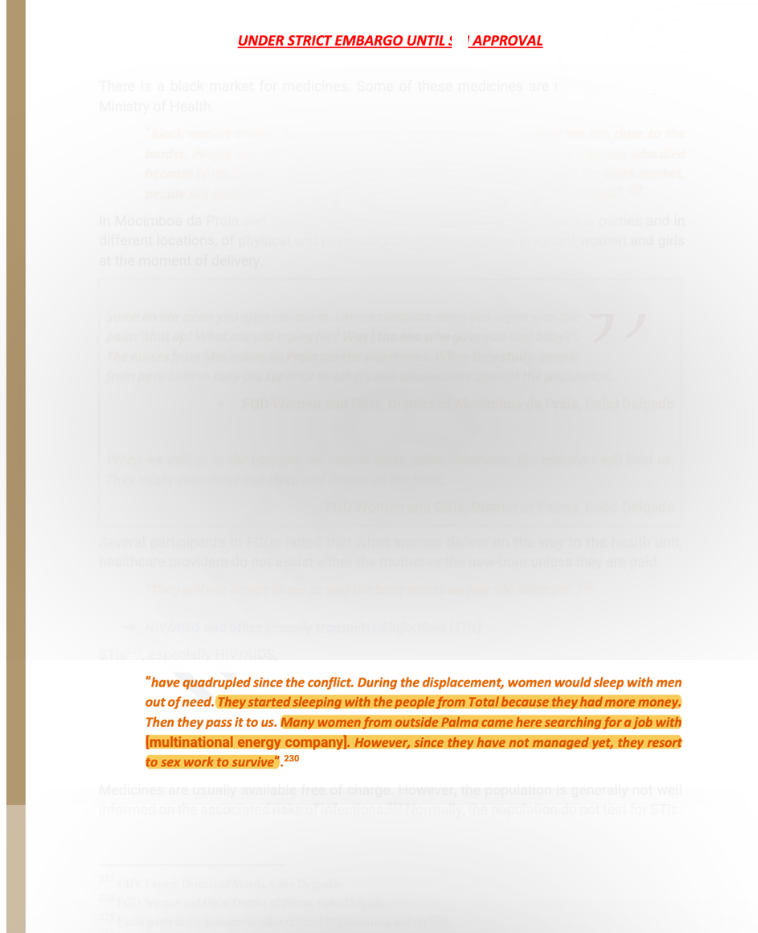
Overwhelmingly, the report exposes sexual violence committed by Mozambique’s armed forces and Al-Shabaab against the women and children of Cabo Delgado. The report also documents the coercion of sex workers by staff associated with TotalEnergies' LNG project. Throughout the report, all but one reference to TotalEnergies was replaced with the term "multinational energy company."
A TotalEnergies spokesperson said that Mozambique LNG “is not aware of such allegations but takes them very seriously.” The project, the spokesperson said, has a mechanism in which people affected by the company’s operations can formally submit concerns. “We have reviewed the grievances lodged in the project grievance mechanism and have no such report,” the spokesperson said.
Asked why the report was never made public, a UN spokesperson said that “operational dynamics and insecurity at the time made it impossible to bring this report up to the standards needed for publication,” adding that the 100-page document had been “used internally to inform programme development.”
“You give your body away”
According to the UN report, women moved to the Palma area hoping to find work around TotalEnergies’ LNG project. Many who were unable to secure employment would “resort to sex work to survive.”
“It’s been very hard because there’s no jobs. I don’t have a means of living. So I have to resort to other ways of providing for my children and my family,” Mwanajuma*, a 27-year-old mother of two whose name was changed for her protection, told the consortium. Mwanajuma said that after being deceived several times, she no longer agrees to sexual relationships for promises of employment. Instead, certain workers on the site demand she pay them to secure a job offer. “They ask for 10,000 meticais [about €135].’ If you don’t have that money, you don’t get the job.”
“They ask women to pay to get the job,” one interviewee told the UN. “The women say they do not have any, so the men say they can get the job if they sleep with them.” Another interviewee said, “they started sleeping with the people from Total because they had more money.”
When asked to identify the men who had attempted to perform such transactions with them, Mwanajuma and Tomazina implicated workers with ISCO, a TotalEnergies subcontractor. ISCO Segurança is a Mozambican security company affiliated with Rwanda-based ISCO Security, which is linked to Crystal Ventures, the investment arm of the ruling Rwandan Patriotic Front (RPF). The company provides security services at the Afungi site .
(ISCO and Crystal Ventures did not reply to our request for comment.)
While it has been a year since Tomazina’s assault, she admitted the experience still weighed heavily on her. “I ask myself why I had to go through all of this. Life is hard, there’s no jobs, someone used that to trick you. You give yourself away, you give your body away, you give them everything, believing this was the time your life was going to improve. But it never does.”
Widespread abuse
In 2025, TotalEnergies relaunched its operations in Cabo Delgado, after a four-year interruption. During that time, it paid Mozambican armed forces for security, to protect its gas installations from Al-Shabaab. Mozambican soldiers, the report stated, are alleged to be responsible for rape, transactional sex, extortion and abuse, including against minors.
A TotalEnergies’ internal report seen by Forbidden Stories, and obtained by ReCommon, an Italian non-profit focusing on corporate accountability issues, shows that the Mozambique LNG project, led by TotalEnergies, "was informed about several cases of JTF [Joint Task Force] misbehaviours in and around the village" in 2022.
One account included in the UN report described an incident involving a teenage girl. “Yesterday, a military officer offered a drink to a girl who was 15-16 years old. Then, he demanded to be paid back for the drink. As she did not have money, he forced her to have sex with him, as a way of payment for the drink. There is a motel over here; we could hear her yelling and crying,” one testimony recounted.
In a 2024 interview with SourceMaterial, a partner on this consortium, Zura*, a 20-year-old resident of Nacala whose name has been changed, recounted crossing paths with three soldiers on her way home from Palma. But they blocked her path and insisted she come to them.
“They tore off my blouse,” she said. “They tied me up and covered my eyes, so I couldn’t see.” Zura said they raped her repeatedly and stole her money. And yet, she felt she had no avenue for redress.
No deterrent justice
Locals have grown wary of the army because of such abuses, as recounted by several civilians who spoke with the consortium. “They don't come to protect us, if they find anything with you they want, they take it forcibly. Did [they] come to protect us or to take our things away?” Mariamo*, a 32-year-old Palma resident whose name has been changed, told the consortium.
Mariamo’s testimony corroborates interviews collected by RFI, a member of Mozambique Exposed, who traveled to Cabo Delgado. “We don't trust them, because they are not trustworthy, they kill the people,” Fatima Alidi, a resident of Mocímboa da Praia, said.
(The Mozambican Ministry of Defence did not reply to Forbidden Stories’ questions.)
According to the report, many victims of sexual violence never obtain justice. This is due, in part, to few courts in the region and the prevalence of informal justice practices. Disputes are often handled informally by the community leader, who “covers it up because they prefer to solve matters through private arrangements.”
For soldiers, there is no deterrent justice within the community, despite many of them having been implicated in child marriages, early pregnancies, and transactional sex. “Even if the perpetrator is detained, the day after, he is walking around in the neighbourhood,” another GBV expert in Pemba told the UN.
Survivors of rape, the report found, won’t report the crime because some members of the military claim to be untouchable. Zura said she reported to police that members of the military raped her and showed them her bloodied clothes, but the soldiers were simply redeployed to an area a few kilometres up the road.
“A fact-free Neverland”
Even if unintentionally, multinational companies like TotalEnergies act as a catalyst for the conflict, Kete Mirela Fumo, a specialist on human rights and corporate abuses for Justiça Ambiental, a Mozambican NGO, told the consortium. “Directly or indirectly, these projects end up worsening the situation, especially when there is information showing that the same projects are funding armed forces that later commit human rights abuses.”
In a 2024 investigation published by Politico, journalist Alex Perry revealed that TotalEnergies paid Mozambican soldiers of a Joint Task Force (JTF). The soldiers were assigned to protect its LNG site in Cabo Delgado and were found to have detained, tortured, and executed dozens, if not hundreds, of civilians around the perimeter of TotalEnergies’ compound. The revelations have since led to legal charges against the company. In late 2025, the European Center for Constitutional and Human Rights (ECCHR) filed a complaint in France accusing TotalEnergies of complicity in war crimes, torture and enforced disappearance of dozens of civilians, and for "having directly financed and materially supported the Joint Task Force... [which] allegedly detained, tortured and killed dozens of civilians on TotalEnergies’ gas site.”
Contacted by the consortium, TotalEnergies said it “firmly rejects all such accusations.” Presumed innocent, it claims that “neither Mozambique LNG nor, a fortiori, TotalEnergies had received, at the time, any information regarding such allegations.”
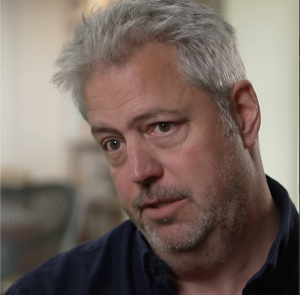
Perry, the journalist, said the company has failed to confront the scale of suffering surrounding the project. “Total won't or doesn't acknowledge any of the stuff that we discovered, ” Perry told ZDF, a member of this consortium. “Total is in a fact-free Neverland,” he said.
Clara Gonzales, a programme director at ECCHR, the organization behind the legal complaint involving TotalEnergies, told the consortium that the company’s stance has been “surprising and cynical.” It will be up to the justice system to establish the facts.
Mariamo, the 32-year-old Palma resident interviewed by the consortium, said a soldier assaulted her after he refused to pay for alcohol she had sold him. The same incident was described in a TotalEnergies’ internal report seen by Forbidden Stories, and obtained by ReCommon. According to the document, Mariamo received medical support through the project and the officer’s “hardship compensation” was suspended before he was removed.
When she reported the incident to police, the soldier threatened her, she told SourceMaterial. “Whatever you can do, no one will imprison me,” she recalled him saying. “We will kill you.”