
By the Numbers
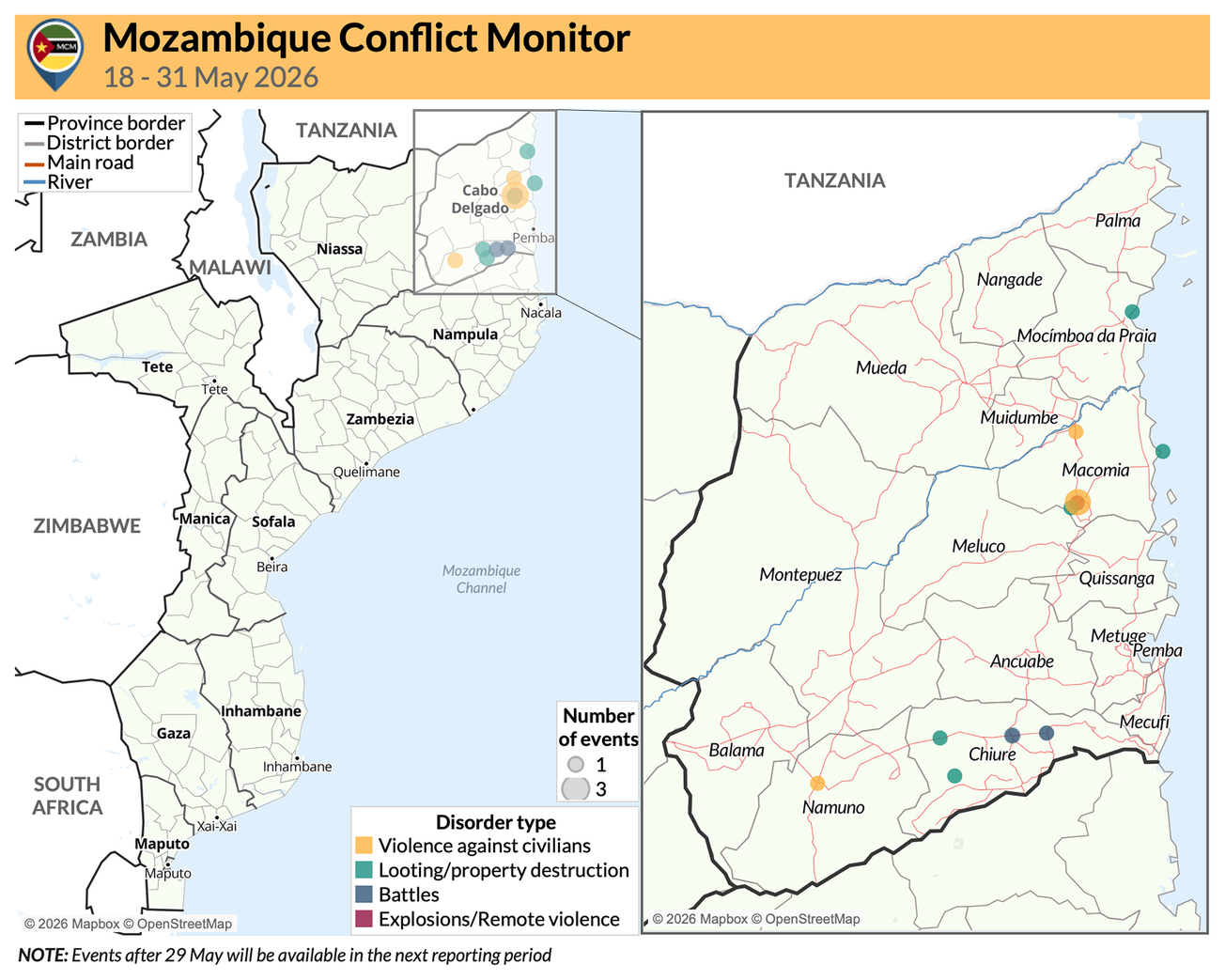
Data highlights in Cabo Delgado province (18 - 31 May 2026)
At least 8 political violence events (2,397 in total since 1 October 2017)
At least 8 total reported fatalities from political violence (6,624 since 1 October 2017)
At least 6 reported civilian fatalities (2,768 since 1 October 2017)
At least 6 political violence events involving ISM across Mozambique (2,214 since 1 October 2017)
Overview
On 25 May, Islamic State Mozambique (ISM) was able to fire mortars at a Mozambican military position on the edges of Macomia, illustrating how fragile the town’s security is. At least three other violent incidents occurred in the town, with some residents blaming the security forces, who in turn blame ISM. To the south, ISM militants remain in Chiúre, though their motivation to be there remains unclear. On the coast, insurgents hijacked at least 12 boats in waters off Mocímboa da Praia and Macomia, illustrating the inability of the Mozambican navy to provide security to boat owners and operators.
Situation summary
Insecurity threatens state control of Macomia town
Despite a significant military presence, with both Mozambican and Rwandan troops deployed in the town, Macomia remains unsafe for both residents and the military. Overall insecurity and a looming ISM presence threaten the state’s control of the town. On 20 May, unidentified armed men shot and killed a man in the Napulubo area of town. The victim, known as Mussa, dealt in fish from the coast. Sources say that armed men had entered the man’s home looking for him one week earlier. Sources differ on the identity of the killers. A security source claimed it was ISM, though local residents say it was the security forces.
Also on 20 May, unidentified armed men raided another businessman’s house in the Nanga A area. The target was not home, and the attackers seized some goods. On 31 May, shots were heard again in the area, with a source saying that the attackers were targeting the same businessman again.
On the southern side of the town, on 25 May, ISM fighters fired five mortars at a Defense Armed Forces of Mozambique (FADM) camp in the CETA area along the road connecting the Macomia town and the Xinavane area to the southwest, according to a claim released by the Islamic State (IS) the following day. No damage or fatalities were reported.
Suspected ISM fighters killed a man in Litamanda village, about 40 kilometers north of Macomia on the N380 road on 21 May. Global Islamic State (IS) media issued a claim for the attack, describing the victim as a “Christian fighter,” though a local source says he was with his family at the time.
Insurgents reach the Lúrio river in Chiúre
ISM has remained in regular contact with IS media managers as it has moved south toward the Lúrio river. IS issued four claims for attacks by its Mozambique affiliate in Chiúre and Namuno districts between 19 and 27 May. As is normal during such sorties, there was minimal reaction from state forces. For an attack on Namoro village in Chiúre district, IS media claimed that ISM killed a member of the “infidel militia,” likely a civilian or Naparama militia member, and burned a church and other property. IS also claimed that the insurgents killed one Mozambican soldier in a clash with a patrol on 27 May, also in Chiúre district.
The objective of this move south is not clear. By 21 May, the group was close to the Lúrio river when they attacked Ingonane village, burning a church. According to one local source, the group wanted to cross to Nampula in order to sell gold they had taken from the Ravia mines in Meluco in April. They may also have wanted to collect recruits from Nampula. There is no evidence yet that they crossed the river.
ISM hijacks fishing boats
In the past fortnight, ISM has targeted Mozambican boat owners. On the night of 20 May, ISM fighters in seven boats surrounded a group of five fishing boats off Pangane, Macomia district. After negotiations with the boats’ owners, a ransom of 60,000 meticais was paid for two boats, and the hijackers seized the remaining three, along with their equipment. The boats were likely taken north to the Messalo river (see the Focus section below).
Four days later, on 24 May, ISM seized seven boats at Ncomangano just north of Mocímboa da Praia town. A source said that the boats were taken south, likely toward the Messalo river. Such activity at Ncomangano is not unprecedented. In July last year, the insurgents seized two boats in the area.
Pundanhar attack sparks uptick in security activity in Palma
Insurgents killed at least three civilians and abducted another three around 17 May in the Pundanhar area, to the west of Palma district. The movement of insurgents in the area may have sparked concerns in Palma town. The following day, restrictions were imposed on vehicles entering the liquefied natural gas project site at Afungi, and a source reported a heightened security presence in the town that day.
Focus: Both ISM and FADM squeeze marine traffic
ISM’s hijacking of at least 12 boats illustrates the pressures on boat crews and boat owners operating off the coast of Macomia and Mocímboa da Praia districts. Since at least March, FADM has attempted to establish an exclusion zone closed to all civilian marine traffic. According to local sources, the zone stretches from Calugo in Mocímboa da Praia to Pequeue in Macomia district (see map below).
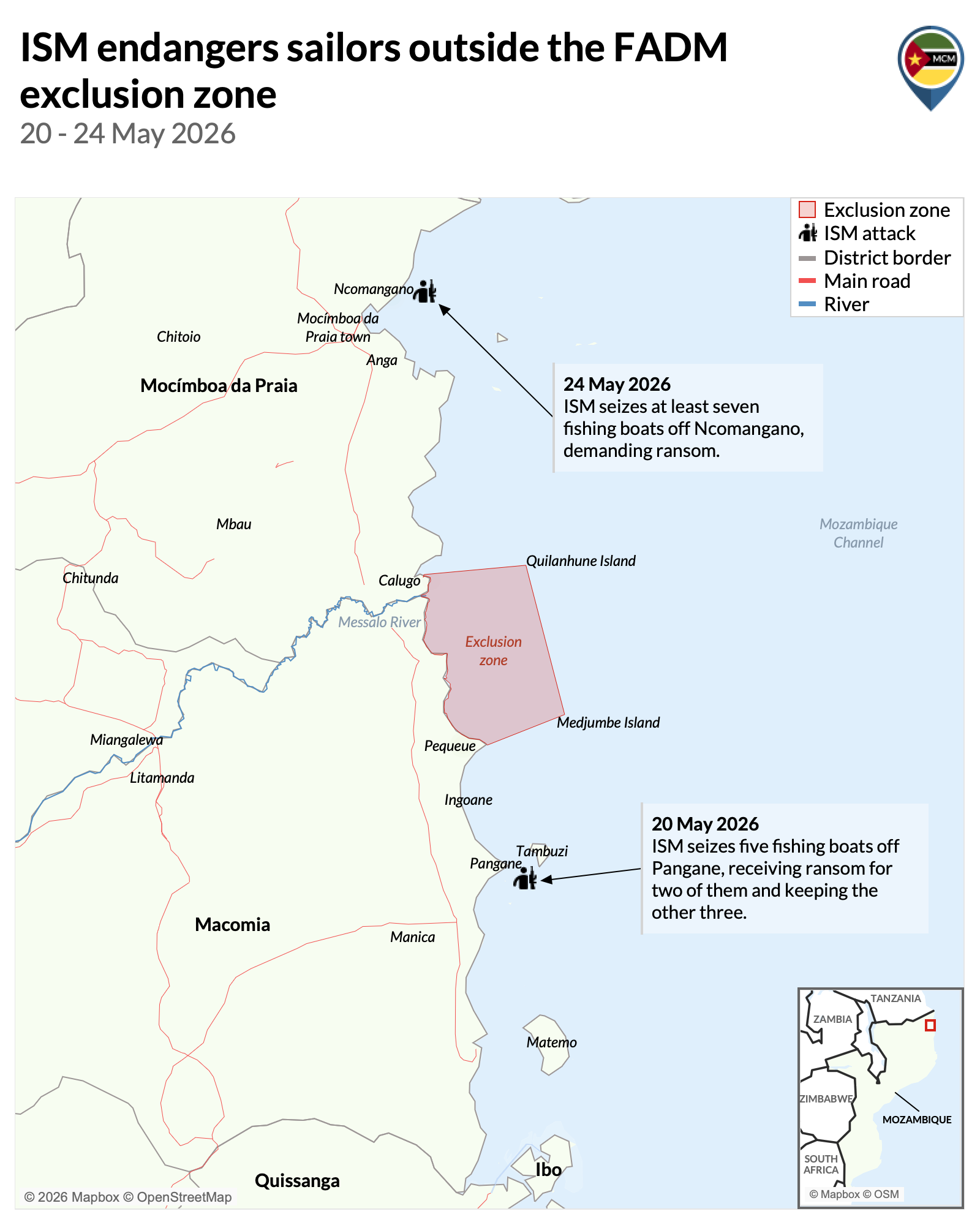
At the heart of the exclusion zone is the mouth of the Messalo river, which acts as a harbor of sorts for ISM marine operations. The purpose of the zone is, presumably, to minimize marine traffic and thus more easily identify ISM movement to and from the Messalo. The river itself is navigable in the rainy season, facilitating access to ISM’s base in the Catupa forest, on the southern bank of the river. The river mouth itself is characterized by mangroves, a significant obstacle to any military operations.
The Mozambican navy sometimes operates on the assumption that any small vessels in the waters off Macomia and Mocímboa da Praia are connected to ISM. For fishers, this has proven deadly. In March, a FADM navy vessel opened fire on a group of fishing boats close to or in the exclusion zone, killing 13. The recent hijackings at Ncomangano and Pangane, with the hijacked boats to be brought to the Messalo, demonstrate that this approach has not deterred ISM.
Recent ISM activity demonstrates that FADM does not have the capacity to patrol waters within or beyond the exclusion zone. We understand that just one boat patrols these waters. If FADM continues to restrict coastal communities’ access to the sea without a significant improvement in naval capacity, counter-insurgency operations will suffer from declining cooperation and worsening access to intelligence.
Roundup
Maputo confirms it will fund Rwandan forces in Cabo Delgado
The Mozambican government has officially confirmed that it will finance the continued presence of Rwandan security forces in Cabo Delgado. Government spokesperson Inocêncio Impissa confirmed the decision, though without disclosing the amounts involved or the duration of the mission. The confirmation aligns Maputo's position with that of Rwanda, whose foreign minister, Olivier Nduhungirehe, announced last month that his government had decided to deal directly and exclusively with the Mozambican government on funding the Rwandan deployment.
The diplomatic groundwork was laid through a series of high-level engagements. President Daniel Chapo met Rwandan President Paul Kagame in Kigali on 13 May, on the margins of the 13th Africa CEO Forum, where the two heads of state discussed bilateral cooperation on security, trade, and investment. Days earlier, Mozambique Defense Minister Cristóvão Artur Chume paid a courtesy visit to Rwanda’s headquarters in Mocímboa da Praia, where Joint Task Force Commander Brigadier General CM Mujuni briefed him on operations across the province. Mozambique's government has framed the foreign troops’ continued presence as a way to buy time and space to reorganize, train, and equip its own forces to eventually take the front line.
Mozambique has simultaneously reinforced its broader regional defense ties. In late May, during a visit to Dar es Salaam, Chume held talks with Tanzanian Minister for Defense and National Service Dr. Rhimo Nyansaho, resulting in the signing of defense and security agreements. The discussions centered on strengthening bilateral cooperation, with emphasis on improving coordination mechanisms, intelligence sharing, and joint responses to evolving security challenges affecting both countries and the wider region.
Mozambique challenges TotalEnergies over $2 billion LNG cost recovery claim
The Mozambican government is reportedly disputing a $2 billion claim by TotalEnergies and its partners linked to cost overruns incurred during the Mozambique LNG project suspension that followed the 2021 force majeure declaration. According to Bloomberg, Maputo is reluctant to accept the estimate, creating a standoff over how the additional costs should be shared. TotalEnergies is said to estimate its total shutdown-related losses at around $4.5 billion and wants to recover these expenses before paying taxes to the state.

)